forums usually have a tag button to add tags in a thread in order to' when somebody searches something (e.g. like me "bs 8110" a few minutes ago etc) to get it fast and not to get as a result all the threads with the term "bs 8110" included.
tags make search more fast and more practical. and take in mind that, forums that didn't organized when the members and the posts were relative few, turned into a mess over the years with the information lost in thousands irrelevant posts and threads
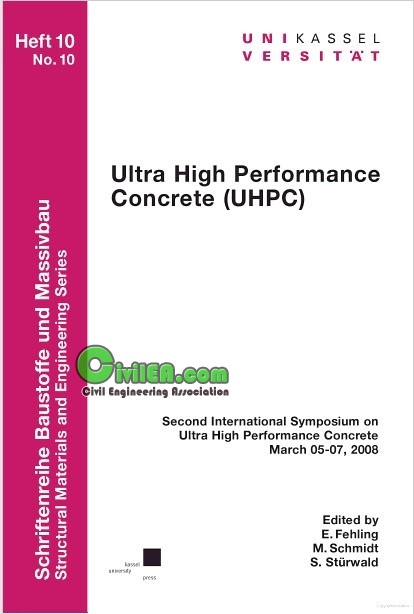
Ultra High Performance Concrete (UHPC) Proceedings of the Second International Symposium on Ultra High Performance Concrete Kassel, Germany March 05-07, 2008
Preface
Ultra High Performance Concrete (UHPC) not only offers superior compressive strength but also extraordinary ductility and far more durability than ordinary concrete. It enables to build structures which are sustainable and economical and come with light and filigree appearance at the same time. During the last four years, since the First International Symposium on Ultra High Performance Concrete held in Kassel in 2004, UHPC has gained much more attendance all over the world, being it by different types of applications for interesting structures or by research on the material itself and the optimization of its production and behaviour. Much of this work has been presented and discussed at the Second International Symposium on Ultra High Performance Concrete in Kassel in 2008 in more than 100 lectures. The presentations have given a broad survey of all aspects of UHPC including raw materials, micro- and macro-structures, mechanical behaviour, durability as well as of construction and design specifications appropriate for this material. Exciting architectural concepts and many examples of interesting engineering applications have been presented at the symposium. The symposium was organized by the Institute of Structural Engineering, Faculty of Civil Engineering of the University of Kassel, Germany. The Conference Proceedings contain the conference papers and presentations. We hope that the conference and the excellent papers will promote further development and exploitation of Ultra High Performance Concrete – one of the most challenging construction material for the 21st century.
Kassel, March 2008
Prof. Dr.-Ing. Ekkehard Fehling Prof. Dr.-Ing. habil. Michael Schmidt
DIRECT LINKS
Code:
Content of this section is hidden, You must be registered and upgrade your account to see this content.
🔽🔽🔽🔽🔽🔽🔽🔽🔽
See this link to read how you can remove this limitation:
👉 CLICK HERE 👈
Code:
Content of this section is hidden, You must be registered and upgrade your account to see this content.
🔽🔽🔽🔽🔽🔽🔽🔽🔽
See this link to read how you can remove this limitation:
👉 CLICK HERE 👈
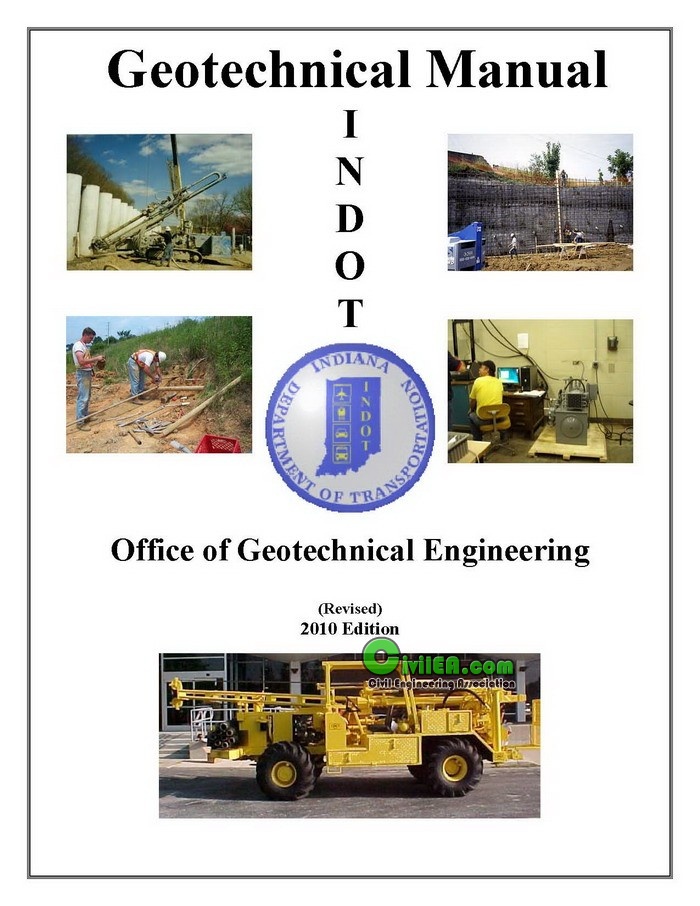
This manual provides background information in geotechnical engineering and design. It also includes guidance for performing geotechnical investigations, preparation of design recommendations, and submittal of the Geotechnical Report. It is based on past Indiana Department of Transportation (referred to herein as “INDOT” or “the Department”) experience, the experience of other groups and agencies with similar requirements, and the current state of the practice in geotechnical engineering. The intent is that this manual will stand on its own; however, to avoid unnecessary duplication, reference is often made to other available manuals and publications of the Department, as well as other references which are readily available. Additionally, since it is impractical to be totally encompassing, and since the state of the practice is continually evolving, some documents are simply referenced as needed.
Code:
Content of this section is hidden, You must be registered and upgrade your account to see this content.
🔽🔽🔽🔽🔽🔽🔽🔽🔽
See this link to read how you can remove this limitation:
👉 CLICK HERE 👈
"Soil moduli and damping factors for dynamic response analyses"
Seed, H. Bolton; Idriss, I. M.
UCB/EERC-70/10, Earthquake Engineering Research Center, University of California, Berkeley, 1970-12, 40 pages (475/S41/1970)
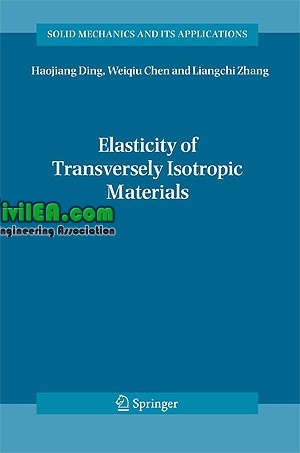
This book presents a comprehensive and systematic analysis of problems of transversely isotropic materials that have wide applications in civil, mechanical, aerospace, materials processing and manufacturing engineering. Various efficient methods based on three-dimensional elasticity are developed under a unified framework, including the displacement method, the stress method, and the state-space method. In particular, a three-dimensional general solution is derived to solve practical problems such as the infinite space, half-space, bimaterial space, layered medium, bodies of revolution, thermal stresses and three-dimensional contact. Exact and analytical solutions are also derived for static and dynamic problems of plates and shells, which may be used as the benchmarks for numerical or approximate analysis. Coupling effects of inner/outer fluids and surrounding elastic media on the free vibration cylindrical and spherical shells are discussed in detail. New state-space formulations are established for the analysis of rectangular plates and spherical shells, from which two independent classes of vibrations can be easily clarified. In short, this is the first monograph on mechanics of transversely isotropic materials, which is unique, covers topics of practical importance and provides many references for the reader.
Code:
Content of this section is hidden, You must be registered and upgrade your account to see this content.
🔽🔽🔽🔽🔽🔽🔽🔽🔽
See this link to read how you can remove this limitation:
👉 CLICK HERE 👈
Earthshaking Science: What We Know (and Don't Know) about Earthquakes
Author: Susan Elizabeth Hough
Edition: illustrated
Publisher: Princeton University Press, 2002
ISBN: 0691050104, 9780691050102
Length: 238 pages
Pdf: 8.3 mB Pdf Quality Condition: 9 points (over 10)
Earthshaking Science is the first book to really make sense of the dizzying array of information that has emerged in recent decades about earthquakes. How do earthquakes start? How do they stop? Do earthquakes occur at regular intervals on faults? If not, why not? Are earthquakes predictable? How hard will the ground shake following an earthquake of a given magnitude? How does one quantify future seismic hazard?As Hough recounts in brisk, jargon-free prose, improvements in earthquake recording capability in the 1960s and 1970s set the stage for a period of rapid development in earthquake science. Although some formidable enigmas have remained, much has been learned on critical issues such as earthquake prediction, seismic hazard assessment, and ground motion prediction. This book addresses those issues.Because earthquake science is so new, it has rarely been presented outside of technical journals that are all but opaque to nonspecialists. Earthshaking Science changes all this. It tackles the issues at the forefront of modern seismology in a way most readers can understand. In it, an expert conveys not only the facts, but the passion and excitement associated with research at the frontiers of this fascinating field.
Code:
Content of this section is hidden, You must be registered and upgrade your account to see this content.
🔽🔽🔽🔽🔽🔽🔽🔽🔽
See this link to read how you can remove this limitation:
👉 CLICK HERE 👈
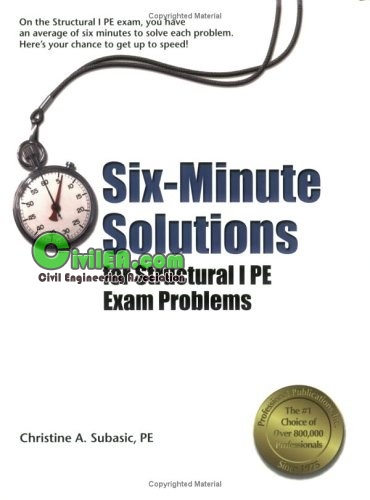
Six-Minute Solutions for Structural PE I Exam Problems
By: Christine A. Subasic (Author)
Paperback: 96 pages
Publisher: Professional Publications (CA) (February 28, 2006)
Language: English
ISBN-10: 1591260701
ISBN-13: 9781591260707
Product Description:
Successfully prepare for the civil PE exam Important strategies on how to solve problems in just minutes 100 challenging multiple-choice problems, just like the exam Two levels of difficulty: 20 general (breadth) problems and 80 more complex (depth) problems A hint for each problem, to help you get started on the right path Step-by-step solutions outlining how to answer problems quickly and correctly Explanations of how to avoid common errors
Code:
Content of this section is hidden, You must be registered and upgrade your account to see this content.
🔽🔽🔽🔽🔽🔽🔽🔽🔽
See this link to read how you can remove this limitation:
👉 CLICK HERE 👈
Code:
Content of this section is hidden, You must be registered and upgrade your account to see this content.
🔽🔽🔽🔽🔽🔽🔽🔽🔽
See this link to read how you can remove this limitation:
👉 CLICK HERE 👈
Hello,
Anybody have this two papers?
Best regards
freequo
Mixed finite element procedure for soil–structure interaction and construction sequences
C. S. Desai, J. G. Lightner
Article first published online: 21 JUN 2005
International Journal for Numerical Methods in Engineering
Volume 21, Issue 5, pages 801–824, May 1985
Huabei Liu, Erxiang Song, Hoe I. Ling,” Constitutive modeling of soil-structure interface
through the concept of critical state soil mechanics”,
Mechanics Research Communications
33 (2006) 515–531
University of Twente in Enschede, the Netherlands, hosted the CIB W115 conference on Life Cycle Design of Buildings Systems and Materials from 12- 15 June 2009. Unique feature of the conference was its attempt to bridge the gap between the theory and practice in the field of sustainable building construction by involving construction Industry (region of Twente, The Netherlands) into the debate during the conference. Innovation in sustainable construction has been presented through number of case studies by the industry members of the Innovation Platform Twente (working Group IDF).
The conference was organized by the University Twente, Innovation Platform Twente ( Working group IDF) and CIB. The emphasis of the conference was on innovative design and construction methods and assessment methods that will incorporate effective use of materials into the whole life cycle of buildings and building materials.
The conventional way of construction has become a burden to the dynamic and changing society of the 21st century. Developers and real estate managers warn that there is a miss-match between the existing building stock and the dynamic and changing demands with respect to the use of buildings and their systems. A report by the World Resource Institute projects 300% rise in material use as world population and economic activity increases over the next 50 years. Steel price is rising. Raw materials are gradually diminishing and becoming expensive, landfill sites are filling up forcing disposal fees to increase and making the waste management exceptionally expensive.
The physical impact of increasing building mass in industrialised nations and developing world has become undeniable in 21st century. The appetite for raw materials and landfill sites, as well as acceleration of the changing demands by users clearly indicates that a fundamental change in the way buildings are designed and constructed is needed.
During the conference the state of the art papers have been presented with respect to life cycle design of buildings and materials. This subject integrates issues from spatial adaptability and flexibility of building systems to material efficiency and energy saving (embodied energy).
Development of the research agenda with respect to this topic deal with issues such as, life cycle performance and strategies, design methodology, systems development, reuse, renewable materials, cad manufacturing, and development of performance measurement tools (transformation capacitymeasurement tool, life cycle costing, life cycle assessments etc.). Background on CIB W115
This CIB W115 Commission on Construction Material Stewardship aims to:
• Drastically reduce the deployment and consumption of new non-renewable construction materials, to replace nonrenewable materials with renewable ones whenever possible, to achieve equilibrium in the demand and supply of renewable materials and ultimately to restore the renewable resource base
• Carry out these tasks in ways to maximize positive financial, social and environmental and ecological sustainability effects, impacts and outcomes.
Code:
Content of this section is hidden, You must be registered and upgrade your account to see this content.
🔽🔽🔽🔽🔽🔽🔽🔽🔽
See this link to read how you can remove this limitation:
👉 CLICK HERE 👈