terms "Hordy bricks", "Hordy block infill", and "...ribbed slab construction utilizing the hordy concrete block infill..."
any one have drawing for slab like this .... i would be so thank full for sharing....
plz...
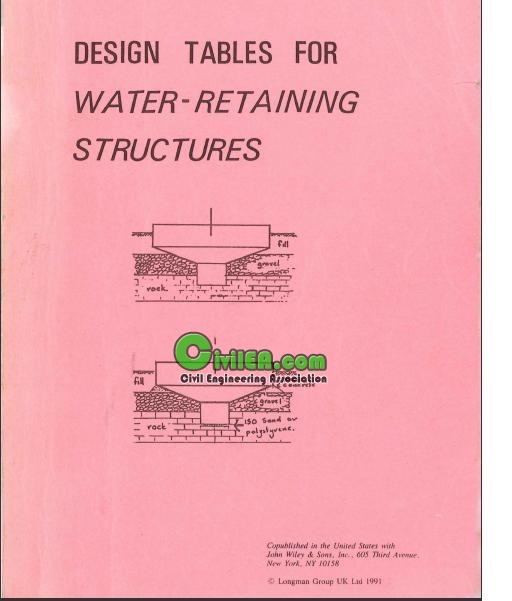
This book provides a comprehensive understanding of the design and construction of waterretaining structures. allowing graduate civil and structural engineering students. as well
as the practising engineer. to design with speed and economy. Assuming some familiarity with BS 8110 Structural Use of Concrete the book draws on examples. many of which
are based on actual completed structures. and upon extensive tables. related to the analysis of rectangular. circular and conical structures, to develop good working practice. The tables and examples will enable the engineer to check, by hand, the often complex results of computer analysis and output. usually based on the finite element method. for most structures. This is particularly so in those cases where the forces within a structure are affected by the ground upon which they sit. Thus, methods of designing for the soil/structure interaction, which normally require the aid of complex computer programs. are included. The tables and examples will prove to be a good reference for carrying out new work to modern methods and regulations. and will give direction to the student engineer in the use of currrent British Standards for the design of many types of concrete structures.
An essential part of the book are the listed computer programs and output which further assist the designer in obtaining a range of options from which the most effective and economical solution may be determined for a particular structure; whilst a useful appendix covers the analysis of ground-supported open circular concrete tanks.
Code:
Content of this section is hidden, You must be registered and upgrade your account to see this content.
🔽🔽🔽🔽🔽🔽🔽🔽🔽
See this link to read how you can remove this limitation:
👉 CLICK HERE 👈
Code:
Content of this section is hidden, You must be registered and upgrade your account to see this content.
🔽🔽🔽🔽🔽🔽🔽🔽🔽
See this link to read how you can remove this limitation:
👉 CLICK HERE 👈
Steels: Metallurgy and Applications, Third Edition
Author: D. T. Llewellyn, Roger C. Hudd | Size: 19.53 MB | Format:PDF | Quality:Unspecified | Publisher: Butterworth-Heinemann | Year: 1998 | pages: 400 | ISBN: 0750637579
STEELS provides a metallurgical understanding of commercial steel grades and the design, manufacturing and service requirements that govern their application. The properties of different steels are described, detailing the effect of composition, processing and heat treatment. Where appropriate an introduction is given to standard specifications and design codes provided on component manufacture and property requirements for successful service performance.
Code:
Content of this section is hidden, You must be registered and upgrade your account to see this content.
🔽🔽🔽🔽🔽🔽🔽🔽🔽
See this link to read how you can remove this limitation:
👉 CLICK HERE 👈
Code:
Content of this section is hidden, You must be registered and upgrade your account to see this content.
🔽🔽🔽🔽🔽🔽🔽🔽🔽
See this link to read how you can remove this limitation:
👉 CLICK HERE 👈
Code:
Content of this section is hidden, You must be registered and upgrade your account to see this content.
🔽🔽🔽🔽🔽🔽🔽🔽🔽
See this link to read how you can remove this limitation:
👉 CLICK HERE 👈
Author: Committee on River Science at the U.S. Geological Survey | Size: 14 MB | Format:PDF | Quality:Unspecified | Publisher: National Research Council | Year: 2007-05-04 | pages: 207 | ISBN: 0309103576
Rivers provide about 60 percent of the nation’s drinking water and irrigation water and 10 percent of the nation’s electric power needs. The multiple and sometimes incompatible services demanded of rivers often lead to policy and management conflicts that require the integration of science-based information. This report advises the U.S. Geological Survey on how it can best address river science challenges by effectively using its resources and coordinating its activities with other agencies. The report identifies the highest priority river science issues for the USGS, including environmental flows and river restoration, sediment transport and geomorphology, and groundwater surface-water interactions. It also recommends two cross-cutting science activities including surveying and mapping the nation’s river systems according to key physical and landscape features, and expanding work on predictive models, especially those that simulate interactions between physical-biological processes. The report identifies key variables to be monitored and data-managed. It proposes enhancements in streamflow, biological, and sediment monitoring; these include establishing multidisciplinary, integrated reach-scale monitoring sites and developing a comprehensive national sediment monitoring program. Finally, it encourages the USGS to be at the forefront of new technology application, including airborne lidar and embedded, networked, wireless sensors.
Code:
Content of this section is hidden, You must be registered and upgrade your account to see this content.
🔽🔽🔽🔽🔽🔽🔽🔽🔽
See this link to read how you can remove this limitation:
👉 CLICK HERE 👈