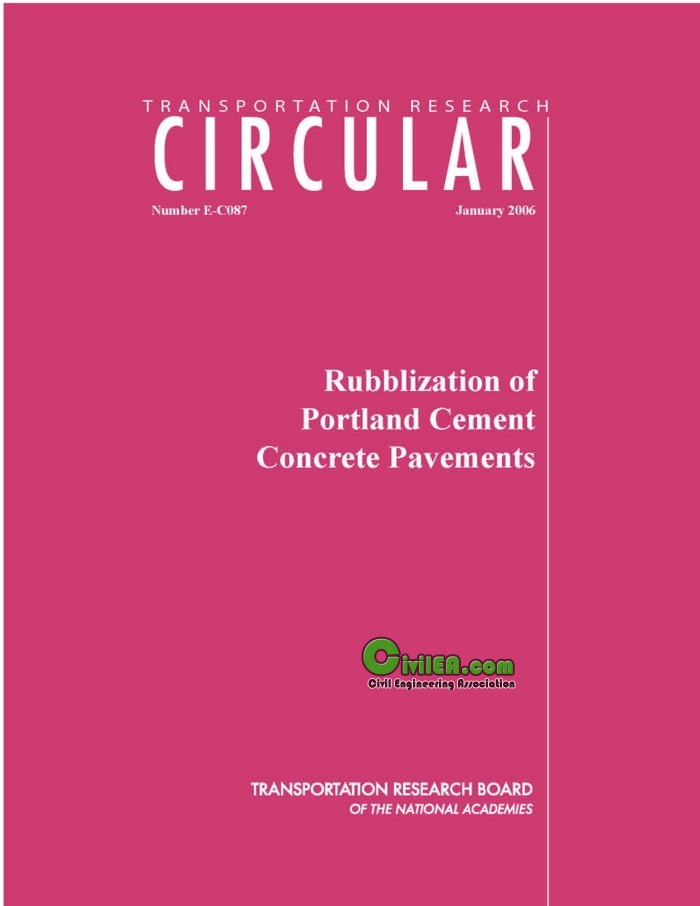
Rehabilitation of existing pavements is a top pavement priority facing local, state, and federal transportation agencies. The use of hot-mix asphalt (HMA) overlays presents a long-term and economical solution to the pavement rehabilitation problem. HMA overlays restore rideability, improve the long-term functional pavement performance as well as increase the structural capacity of the existing pavement system. Due to the expense, time and traffic delay involved in concrete pavement restoration (CPR) and reconstruction, resurfacing of portland cement concrete (PCC) pavements with an HMA overlay is a very appealing option for many agencies. However, existing, worn-out PCC pavements present a particular problem for rehabilitation due to the likelihood of reflection cracking when an HMA overlay is placed. The reflection cracking problem must be addressed in the HMA overlay design phase if long-term performance of the overlay is to be achieved. The objective of rubblization is to eliminate reflection cracking in the HMA overlay by the total destruction of the existing slab action of the PCC pavement. This process is normally achieved by rubblizing the slab into fragments. Temperature and/or reinforcing steel, if present in the PCC pavement, is generally fully debonded from the concrete by this approach. The rubblization process is applicable to all types of existing PCC pavements. The objective of this paper is to provide an overview of current design and construction guidelines specific to the PCC rubblization process. A procedure is presented for determining the required thickness of an HMA overlay placed over rubblized PCC slabs as well as guidelines for construction.
Code:
Content of this section is hidden, You must be registered and upgrade your account to see this content.
🔽🔽🔽🔽🔽🔽🔽🔽🔽
See this link to read how you can remove this limitation:
👉 CLICK HERE 👈
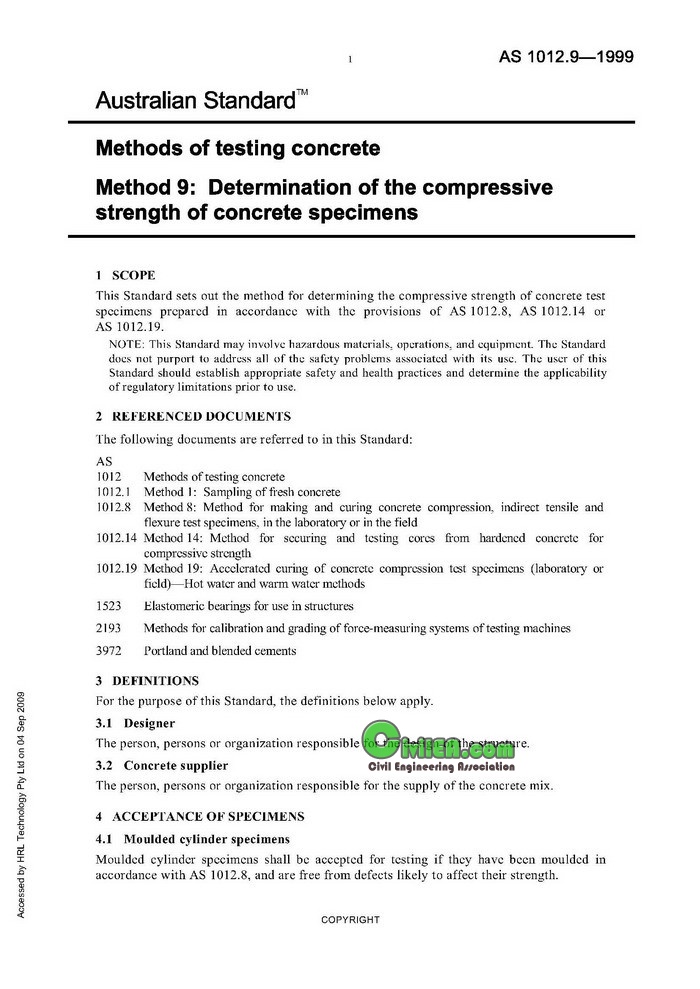
This Standard sets out the method for determining the compressive strength of concrete test specimens prepared in accordance with the provisions of AS 1012.8, AS 1012.14 or AS 1012.19.
NOTE: This Standard may involve hazardous materials, operations, and equipment. The Standard does not purport to address all of the safety problems associated with its use. The user of this Standard should establish appropriate safety and health practices and determine the applicability of regulatory limitations prior to use.
Code:
Content of this section is hidden, You must be registered and upgrade your account to see this content.
🔽🔽🔽🔽🔽🔽🔽🔽🔽
See this link to read how you can remove this limitation:
👉 CLICK HERE 👈
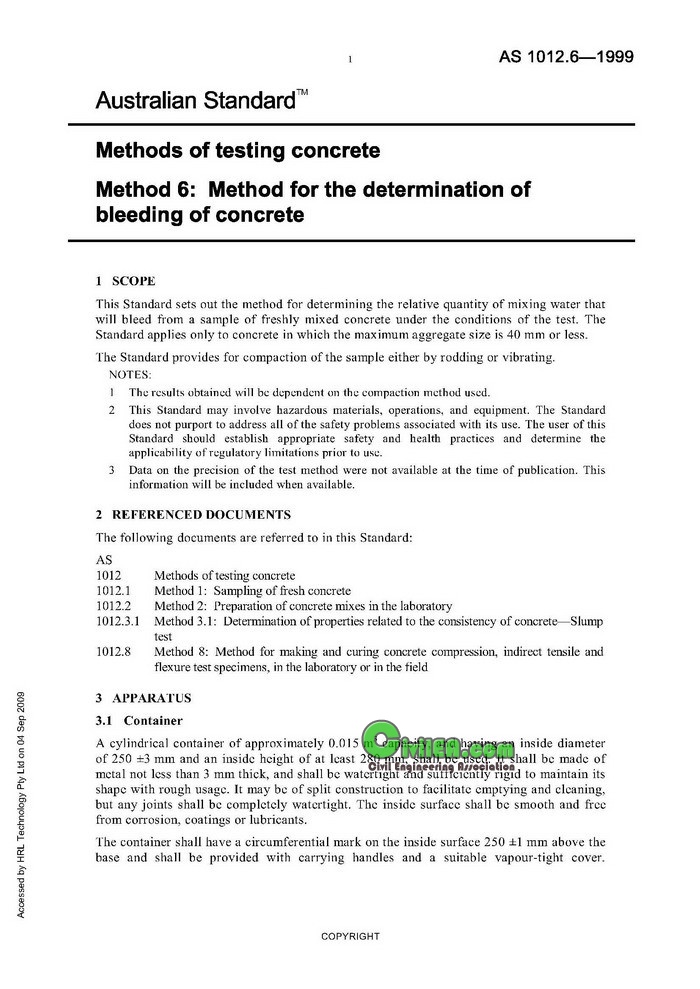
This Standard sets out the method for determining the relative quantity of mixing water that will bleed from a sample of freshly mixed concrete under the conditions of the test. The Standard applies only to concrete in which the maximum aggregate size is 40 mm or less.
The Standard provides for compaction of the sample either by rodding or vibrating.
NOTES:
1 The results obtained will be dependent on the compaction method used.
2 This Standard may involve hazardous materials, operations, and equipment. The Standard does not purport to address all of the safety problems associated with its use. The user of this Standard should establish appropriate safety and health practices and determine the applicability of regulatory limitations prior to use.
3 Data on the precision of the test method were not available at the time of publication. This information will be included when available.
Code:
Content of this section is hidden, You must be registered and upgrade your account to see this content.
🔽🔽🔽🔽🔽🔽🔽🔽🔽
See this link to read how you can remove this limitation:
👉 CLICK HERE 👈
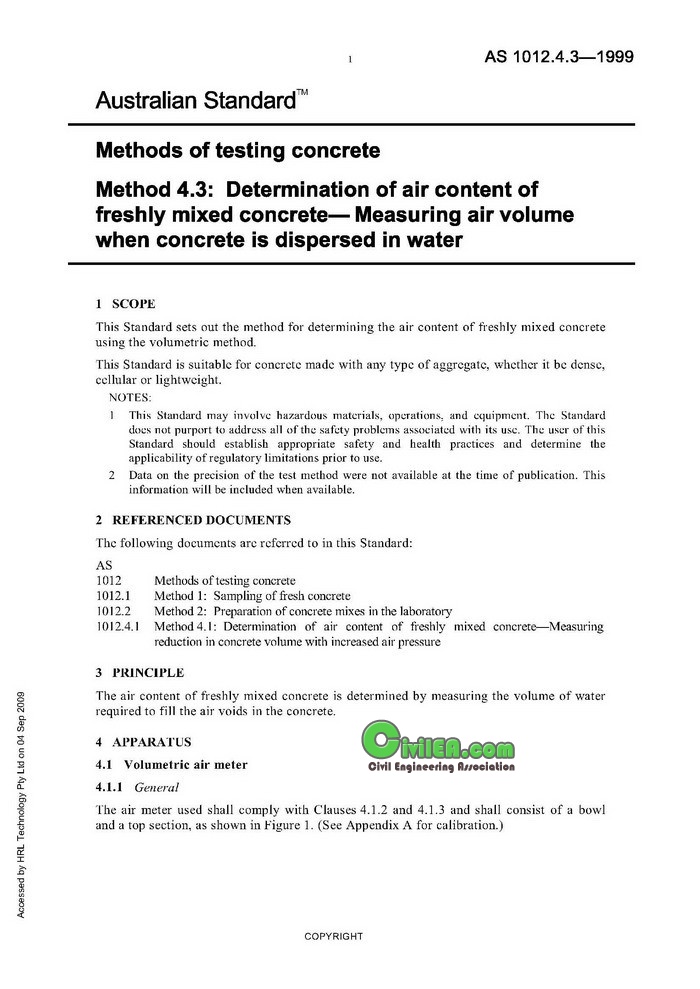
This Standard sets out the method for determining the air content of freshly mixed concrete using the volumetric method.
This Standard is suitable for concrete made with any type of aggregate, whether it be dense, cellular or lightweight.
NOTES:
1 This Standard may involve hazardous materials, operations, and equipment. The Standard does not purport to address all of the safety problems associated with its use. The user of this Standard should establish appropriate safety and health practices and determine the applicability of regulatory limitations prior to use.
2 Data on the precision of the test method were not available at the time of publication. This information will be included when available.
Code:
Content of this section is hidden, You must be registered and upgrade your account to see this content.
🔽🔽🔽🔽🔽🔽🔽🔽🔽
See this link to read how you can remove this limitation:
👉 CLICK HERE 👈
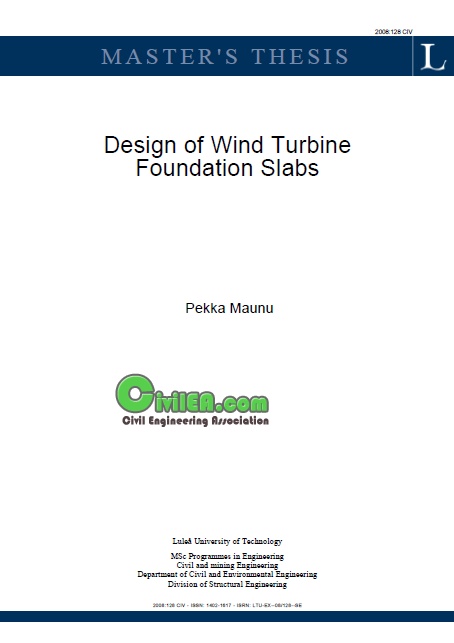
Author: Pekka Maunu | Size: 5,29 MB | Format:PDF | Publisher: Lulea University of tecnology | Year: 2008 | pages: 91 | ISBN: THESIS
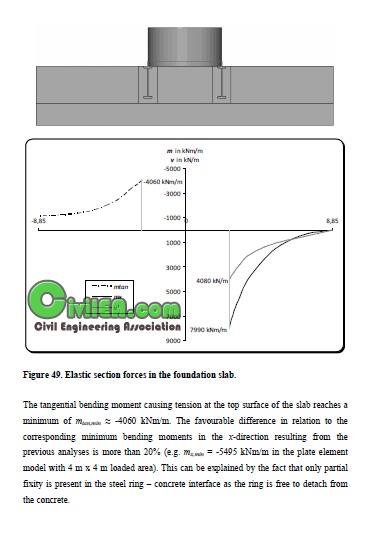
Study of structural behavior of wind turbine foundation slabs analyzed with various numerical and analytical models. The studied methods includes suitable models for handy-calculations, finite elements models with plate element resting on springs as well as three dimensional models of both the foundation slab and the soil. Linear elastic as well as nonlinear behavior including cracking of concrete and the complex load transfer from the tower into the foundation through a steel ring.
DIRECT LINKS
Code:
Content of this section is hidden, You must be registered and upgrade your account to see this content.
🔽🔽🔽🔽🔽🔽🔽🔽🔽
See this link to read how you can remove this limitation:
👉 CLICK HERE 👈
Autodesk Subscription Pack 2012 - a unique collection of all the currently available add-ons for all versions of Autodesk products in 2012, called Subscription Pack's (and more) are available to subscribers only licensed Autodesk Inc.
ArchVision RPC Content for AutoCAD Architecture 2012 and AutoCAD MEP 2012 (English)
Release Date: 25/03/2011
AutoCAD ® Architecture 2012 and AutoCAD ® MEP 2012 subscription customers now have access to a library of Rich Photorealistic Content (RPC ™) from ArchVision ®. The library consists of over 100 high-quality images of people, vehicles and plants, enabling users to transform renderings into effective, lifelike scenes. Using RPC images, objects can be added without sacrificing rendering performance.
ObjectARX - a set of additional libraries in C + + libraries to AutoCAD, which allows extending the standard and create your own classes and objects in AutoCAD, to define new commands and LISP-functions.
The package provides developers with tools for creating so-called ARX-application: dll files, please contact directly to the methods and properties of AutoCAD objects in its address space. That is, this technology makes in AutoCAD software with the "almost open " code.
Autodesk has begun the transition of Visual Basic customization from VBA to. NET technology. Currently, VBA is still supported in Autodesk products however VBA is no longer part of the default AutoCAD installation and must be downloaded and installed separately. If you utilize VBA macros in your work environment, they will no longer work unless the VBA module is installed on your system.
DIALux Plug-in for AutoCAD MEP 2012 ( English )
Release Date: 2011-03-25
The DIALux Plug-in for AutoCAD® MEP 2012 software provides a bi-directional link between AutoCAD MEP and DIALux, a lighting design, calculation and analysis tool. By using this extension, MEP designers and drafters can export space boundaries from AutoCAD MEP 2012 into DIALux, making room generation quicker and easier, and import lighting fixture layouts. Users can then take advantage of the design tools and manufacturers specific database in DIALux before exporting lighting fixture layouts back to AutoCAD MEP 2012.
Content is available in English only.
Code:
Content of this section is hidden, You must be registered and upgrade your account to see this content.
🔽🔽🔽🔽🔽🔽🔽🔽🔽
See this link to read how you can remove this limitation:
👉 CLICK HERE 👈
or
Code:
Content of this section is hidden, You must be registered and upgrade your account to see this content.
🔽🔽🔽🔽🔽🔽🔽🔽🔽
See this link to read how you can remove this limitation:
👉 CLICK HERE 👈
Code:
Content of this section is hidden, You must be registered and upgrade your account to see this content.
🔽🔽🔽🔽🔽🔽🔽🔽🔽
See this link to read how you can remove this limitation:
👉 CLICK HERE 👈
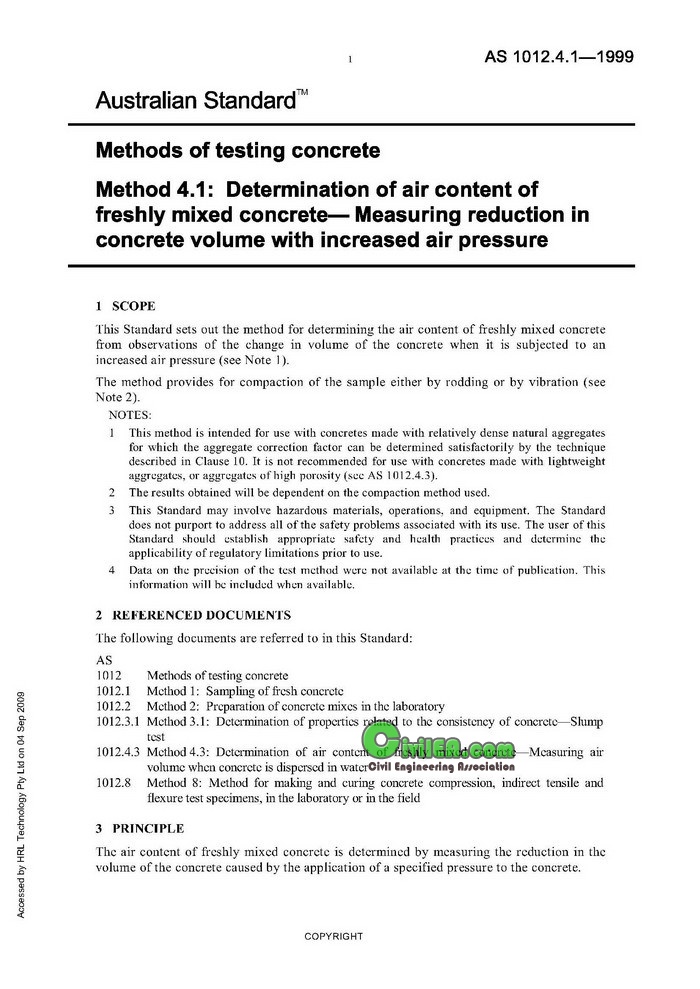
This Standard sets out the method for determining the air content of freshly mixed concrete from observations of the change in volume of the concrete when it is subjected to an increased air pressure (see Note 1). The method provides for compaction of the sample either by rodding or by vibration (see Note 2).
NOTES:
1 This method is intended for use with concretes made with relatively dense natural aggregates for which the aggregate correction factor can be determined satisfactorily by the technique described in Clause 10. It is not recommended for use with concretes made with lightweight aggregates, or aggregates of high porosity (see AS 1012.4.3).
2 The results obtained will be dependent on the compaction method used.
3 This Standard may involve hazardous materials, operations, and equipment. The Standard does not purport to address all of the safety problems associated with its use. The user of this Standard should establish appropriate safety and health practices and determine the applicability of regulatory limitations prior to use.
4 Data on the precision of the test method were not available at the time of publication. This information will be included when available.
Code:
Content of this section is hidden, You must be registered and upgrade your account to see this content.
🔽🔽🔽🔽🔽🔽🔽🔽🔽
See this link to read how you can remove this limitation:
👉 CLICK HERE 👈
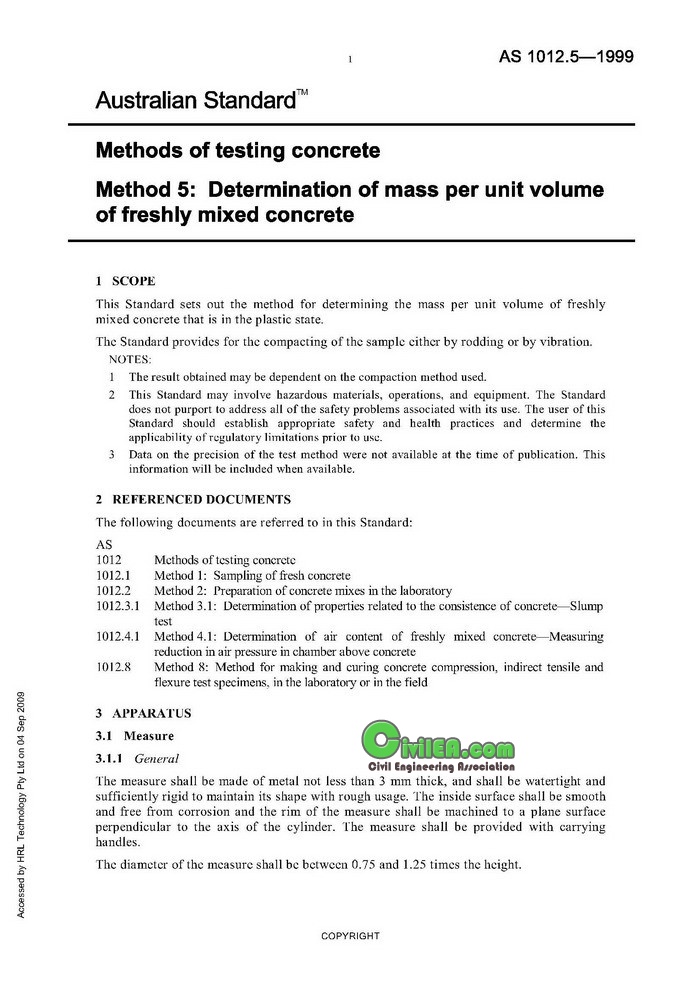
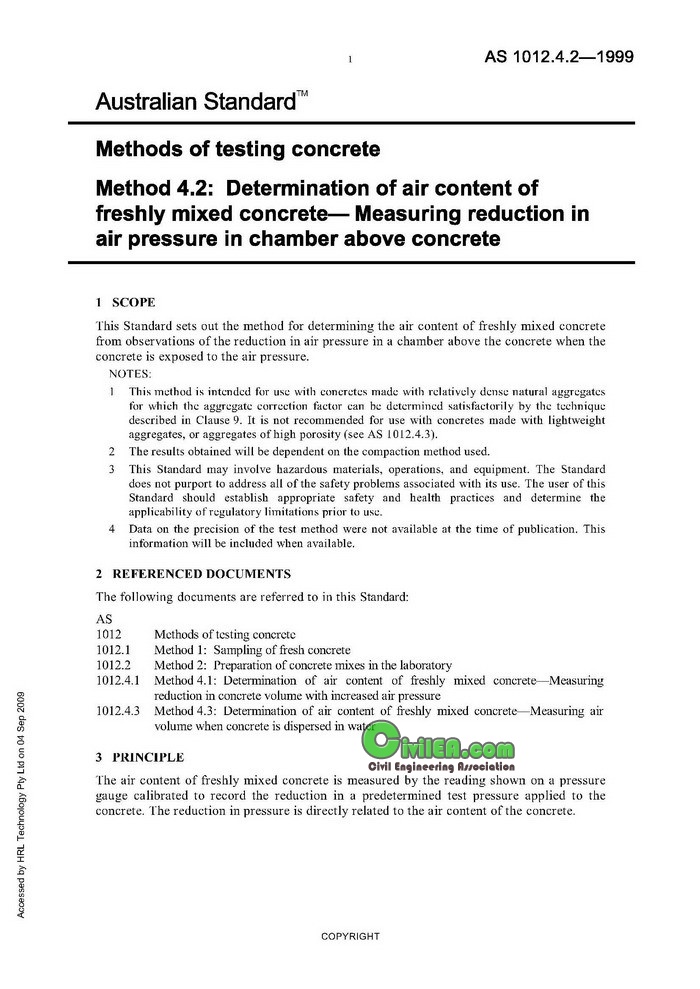
This Standard sets out the method for determining the air content of freshly mixed concrete from observations of the reduction in air pressure in a chamber above the concrete when the concrete is exposed to the air pressure.
NOTES:
1 This method is intended for use with concretes made with relatively dense natural aggregates for which the aggregate correction factor can be determined satisfactorily by the technique described in Clause 9. It is not recommended for use with concretes made with lightweight aggregates, or aggregates of high porosity (see AS 1012.4.3).
2 The results obtained will be dependent on the compaction method used.
3 This Standard may involve hazardous materials, operations, and equipment. The Standard does not purport to address all of the safety problems associated with its use. The user of this Standard should establish appropriate safety and health practices and determine the applicability of regulatory limitations prior to use.
4 Data on the precision of the test method were not available at the time of publication. This information will be included when available.
Code:
Content of this section is hidden, You must be registered and upgrade your account to see this content.
🔽🔽🔽🔽🔽🔽🔽🔽🔽
See this link to read how you can remove this limitation:
👉 CLICK HERE 👈
This Standard sets out the method for determining the air content of freshly mixed concrete using the volumetric method.
This Standard is suitable for concrete made with any type of aggregate, whether it be dense, cellular or lightweight.
NOTES:
1 This Standard may involve hazardous materials, operations, and equipment. The Standard does not purport to address all of the safety problems associated with its use. The user of this Standard should establish appropriate safety and health practices and determine the applicability of regulatory limitations prior to use.
2 Data on the precision of the test method were not available at the time of publication. This information will be included when available.
Code:
Content of this section is hidden, You must be registered and upgrade your account to see this content.
🔽🔽🔽🔽🔽🔽🔽🔽🔽
See this link to read how you can remove this limitation:
👉 CLICK HERE 👈
There has been a steady increase in anthropogenic pressure over the past few years due to rapid industrialization, urbanization and population growth, causing frequent environmental hazards. Threats of global environmental change, such as climate change and sea level rise, will exacerbate such problems. Therefore, appropriate policies and measures are needed for management to address both local and global trends. The book 'Environmental Management' provides a comprehensive and authoritative account of sustainable environmental management of diverse ecotypes, from tropical to temperate. A variety of regional environmental issues with the respective remedial measures has been precisely illustrated. The book provides an excellent text which offers a versatile and in-depth account of management of wide perspectives, e.g. waste management, lake, coastal and water management, high mountain ecosystem as well as viticulture management. We hope that this publication will be a reference document to serve the needs of researchers of various disciplines, policy makers, planners and administrators as well as stakeholders to formulate strategies for sustainable management of emerging environmental issues.
DIRECT LINKS
Code:
Content of this section is hidden, You must be registered and upgrade your account to see this content.
🔽🔽🔽🔽🔽🔽🔽🔽🔽
See this link to read how you can remove this limitation:
👉 CLICK HERE 👈
Code:
Content of this section is hidden, You must be registered and upgrade your account to see this content.
🔽🔽🔽🔽🔽🔽🔽🔽🔽
See this link to read how you can remove this limitation:
👉 CLICK HERE 👈
By adopting the principles of sustainable design and cleaner production, this important book opens a new challenge in the world of composite materials and explores the achieved advancements of specialists in their respective areas of research and innovation. Contributions coming from both spaces of academia and industry were so diversified that the 28 chapters composing the book have been grouped into the following main parts: sustainable materials and ecodesign aspects, composite materials and curing processes, modelling and testing, strength of adhesive joints, characterization and thermal behaviour, all of which provides an invaluable overview of this fascinating subject area. Results achieved from theoretical, numerical and experimental investigations can help designers, manufacturers and suppliers involved with high-tech composite materials to boost competitiveness and innovation productivity.
DIRECT LINKS
Code:
Content of this section is hidden, You must be registered and upgrade your account to see this content.
🔽🔽🔽🔽🔽🔽🔽🔽🔽
See this link to read how you can remove this limitation:
👉 CLICK HERE 👈
Code:
Content of this section is hidden, You must be registered and upgrade your account to see this content.
🔽🔽🔽🔽🔽🔽🔽🔽🔽
See this link to read how you can remove this limitation:
👉 CLICK HERE 👈