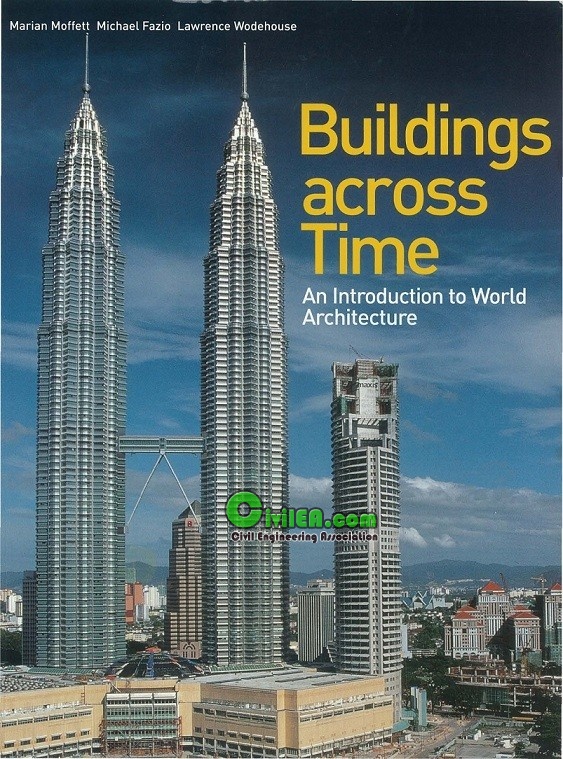
Buildings across Time: An Introduction to World Architecture
Author: Marian Moffett, Michael Fazio, Lawrence Wodehouse | Size: 123 MB | Format:PDF | Quality:Unspecified | Publisher: McGraw-Hill | Year: 2003 | pages: 608 | ISBN: 9780767405119
This heavily illustrated survey has been expanded in its second edition to provide students of both art history and of architecture with a worldwide introduction to the history of architecture.
Code:
Content of this section is hidden, You must be registered and upgrade your account to see this content.
🔽🔽🔽🔽🔽🔽🔽🔽🔽
See this link to read how you can remove this limitation:
👉 CLICK HERE 👈
Code:
Content of this section is hidden, You must be registered and upgrade your account to see this content.
🔽🔽🔽🔽🔽🔽🔽🔽🔽
See this link to read how you can remove this limitation:
👉 CLICK HERE 👈
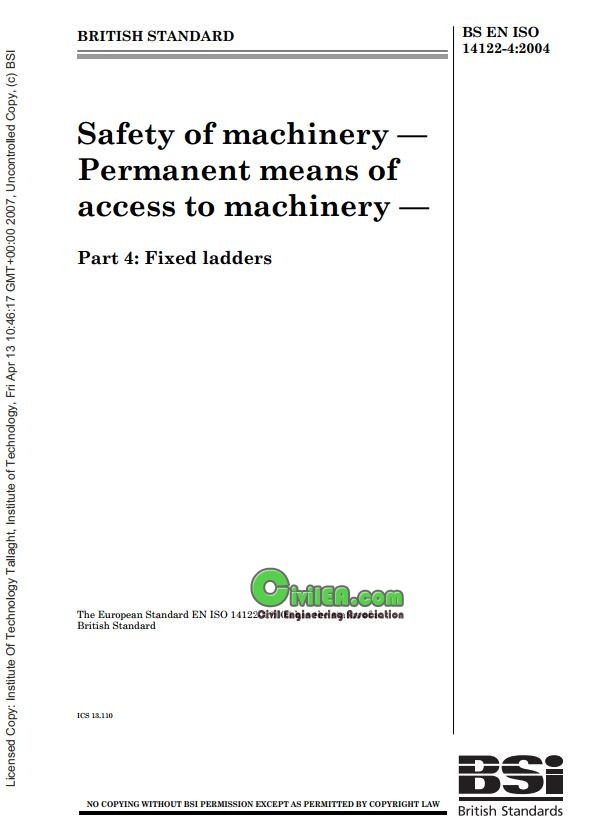
This standard defines the general requirements for safe access to machines and gives advice about the correct choice of access means when the necessary access to the machine is not possible directly from the ground level or from a floor.
This standard applies to all machinery (stationary and mobile) where fixed means of access are necessary, and to fixed ladders, which are a part of a machine.
It may be applied to fixed ladders to that part of the building where the machine is installed, providing the main function of that part of the building is to provide a means of access to the machine.
This part also applies to ladders which are not permanently fixed to the machine and which may be removed, moved to the side or pivoted (swivel-mounted) for some operations of the machine (e. g. changing tools in a large press).
BS EN ISO 14122 consists of the following parts, under the general title "Safety of machinery - Permanent means of access to machinery" :
• Part 1 : Choice of a fixed means of access between two levels
• Part 2 : Working platforms and walkways
• Part 3 : Stairs, stepladders and guard-rails
• Part 4 : Fixed ladders.
Code:
Content of this section is hidden, You must be registered and upgrade your account to see this content.
🔽🔽🔽🔽🔽🔽🔽🔽🔽
See this link to read how you can remove this limitation:
👉 CLICK HERE 👈
Code:
Content of this section is hidden, You must be registered and upgrade your account to see this content.
🔽🔽🔽🔽🔽🔽🔽🔽🔽
See this link to read how you can remove this limitation:
👉 CLICK HERE 👈
Author: National Research Council | Size: 9.62 MB | Format:PDF | Quality:Original preprint | Publisher: National Academies Press | Year: 1993 | pages: 496 | ISBN: 0309048265, 9780309048262
Although significant progress has been made in improving the nation's water quality over the past 20 years, many coastal areas continue to suffer from persistent environmental problems and can expect to encounter new problems in the future. Today's coastal water-quality management practices do not provide adequate protection from some types of problems and in some cases are overprotective of other types of problems. Much of the debate over how to protect and improve coastal water-quality has focused on urban wastewater and stormwater management.
This report, as requested of the National Research Council by the U.S. Environmental Protection Agency (EPA) at the direction of Congress, examines issues relevant to wastewater management in coastal urban areas. These issues include environmental objectives, policies, and regulations; technology; management techniques; systems analysis and design; and environmental modeling. The National Research Council was not asked to review past policies or decisions. Instead, it was directed to identify opportunities for improving the current system through which coastal urban wastewater and stormwater are managed. The report identifies several key areas in which specific progress could be made, and recommends a new framework for coastal management toward which current management practices should evolve. It addresses the management of marine and estuarine areas in particular and does not consider the Great Lakes.
The scope of activities involved in the management of wastewater and stormwater in coastal cities is large and complex. In the broadest terms, the purpose of managing these wastes is to protect the environment while using it for waste disposal. At least 37 percent of the United States' population resides along the coast, mostly in urban areas. More than 1,400 municipal wastewater treatment plants provide service to the coastal population, discharging 10 billion gallons of treated effluent per day. During the period from 1972 to 1992, about $76 billion were spent in constructing or expanding publicly owned treatment works; $50 billion of this total came from federal grants. At an estimated operating cost ranging from $300 to $500 per million gallons of treated effluent, the national expenditure for operating these plants is between $1.1 billion and $1.8 billion per year.
The management of wastewater and stormwater in coastal urban areas takes place in the context of a multitude of other human activities and natural processes within the coastal zone. Some major factors that cause perturbations in the coastal zone include, in no special order, municipal wastewater and stormwater discharges; combined sewer overflows; other urban runoff; direct industrial wastewater discharges; agricultural runoff; atmospheric deposition; ground water flow; boating traffic; shipping; dredging and filling; leaching of contaminated sediments; oil and gas production; introduction of nonindigenous species; harvesting of fish and shellfish; freshwater impoundment and diversion; and land-use changes in coastal drainage basins.
Code:
Content of this section is hidden, You must be registered and upgrade your account to see this content.
🔽🔽🔽🔽🔽🔽🔽🔽🔽
See this link to read how you can remove this limitation:
👉 CLICK HERE 👈
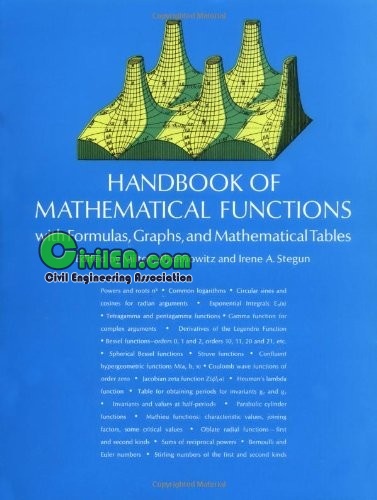
Students and professionals in the fields of mathematics, physics, engineering, and economics will find this reference work invaluable. A classic resource for working with special functions, standard trig, and exponential logarithmic definitions and extensions, it features 29 sets of tables, some to as high as 20 places.
Code:
Content of this section is hidden, You must be registered and upgrade your account to see this content.
🔽🔽🔽🔽🔽🔽🔽🔽🔽
See this link to read how you can remove this limitation:
👉 CLICK HERE 👈
10th ed. (1972) - djvu format, 10 MB
Code:
Content of this section is hidden, You must be registered and upgrade your account to see this content.
🔽🔽🔽🔽🔽🔽🔽🔽🔽
See this link to read how you can remove this limitation:
👉 CLICK HERE 👈
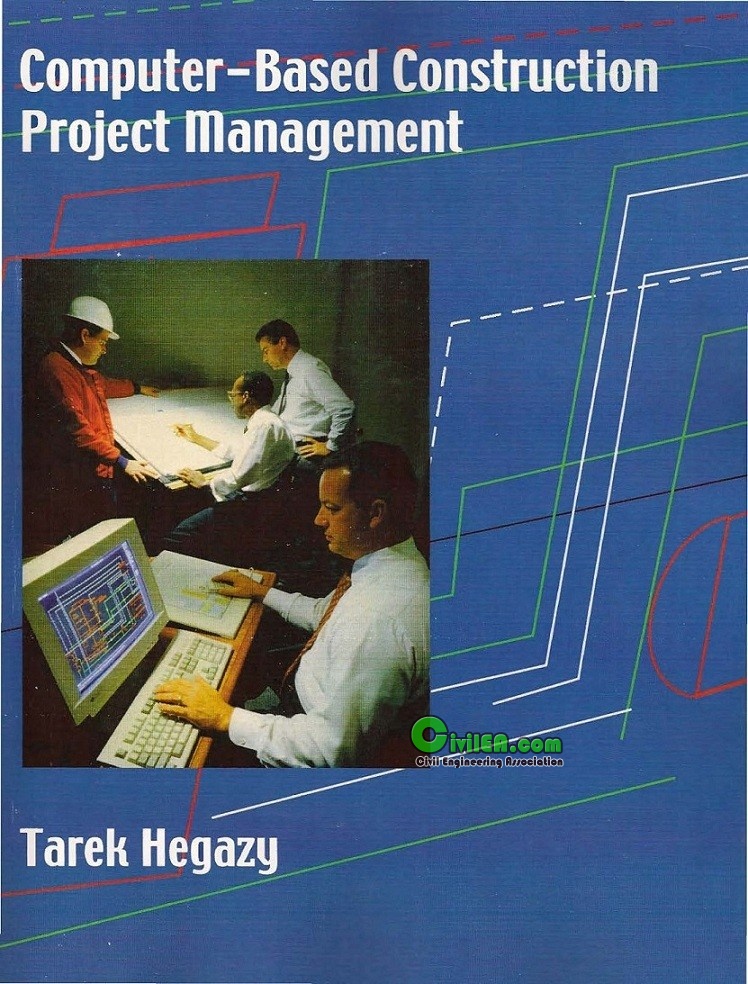
Computer-Based Construction Project Management focuses on the use of computers to cope with the construction challenges of tight budgets, strict deadlines, and limited resources. Coverage includes areas such as contracts, estimating and scheduling, resource management, bidding, cash management, and project control. Readers will develop skills to analyze projects and use computers to optimize resource use
Code:
Content of this section is hidden, You must be registered and upgrade your account to see this content.
🔽🔽🔽🔽🔽🔽🔽🔽🔽
See this link to read how you can remove this limitation:
👉 CLICK HERE 👈
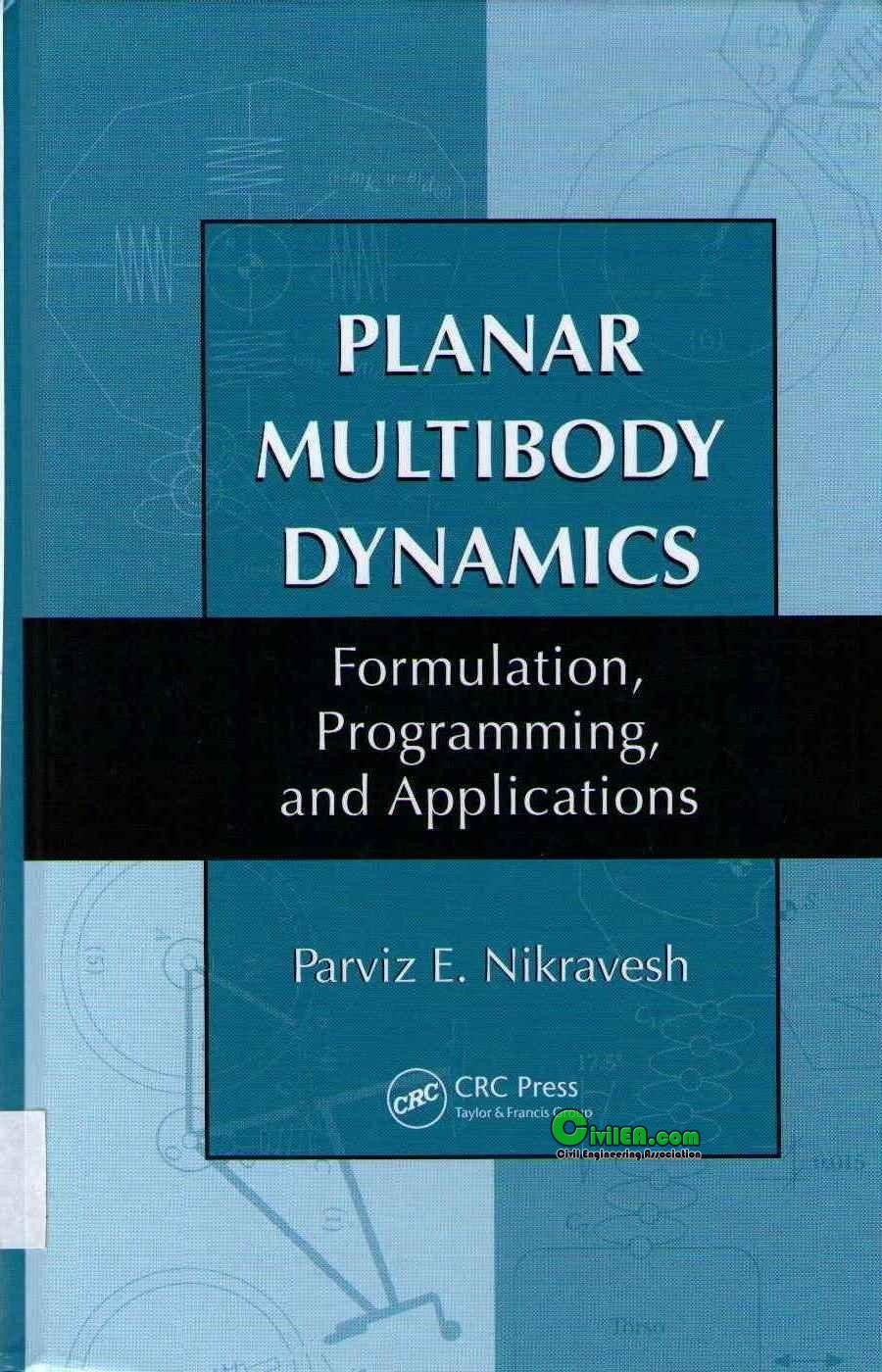
Written by Parviz Nikravesh, one of the world’s best known experts in multibody dynamics, Planar Multibody Dynamics: Formulation, Programming, and Applications enhances the quality and ease of design education with extensive use of the latest computerized design tools combined with coverage of classical design and dynamics of machinery principles.
Using language that is clear, concise, and to the point, the textbook introduces fundamental theories, computational methods, and program development for analyzing simple to complex planar mechanical systems. The author chose MATLAB® as the programming language, and since students may not be skilled programmers, the examples and exercises provide a tutorial for learning MATLAB. The examples begin with basic commands before introducing students to more advanced programming techniques. The routines developed in each chapter eventually come together to form complete programs for different types of analysis.
Code:
Content of this section is hidden, You must be registered and upgrade your account to see this content.
🔽🔽🔽🔽🔽🔽🔽🔽🔽
See this link to read how you can remove this limitation:
👉 CLICK HERE 👈
Direct Link
[MIRROR]Content of this section is hidden, You must be registered and upgrade your account to see this content.
[/MIRROR] 🔽🔽🔽🔽🔽🔽🔽🔽🔽
See this link to read how you can remove this limitation:
👉 CLICK HERE 👈
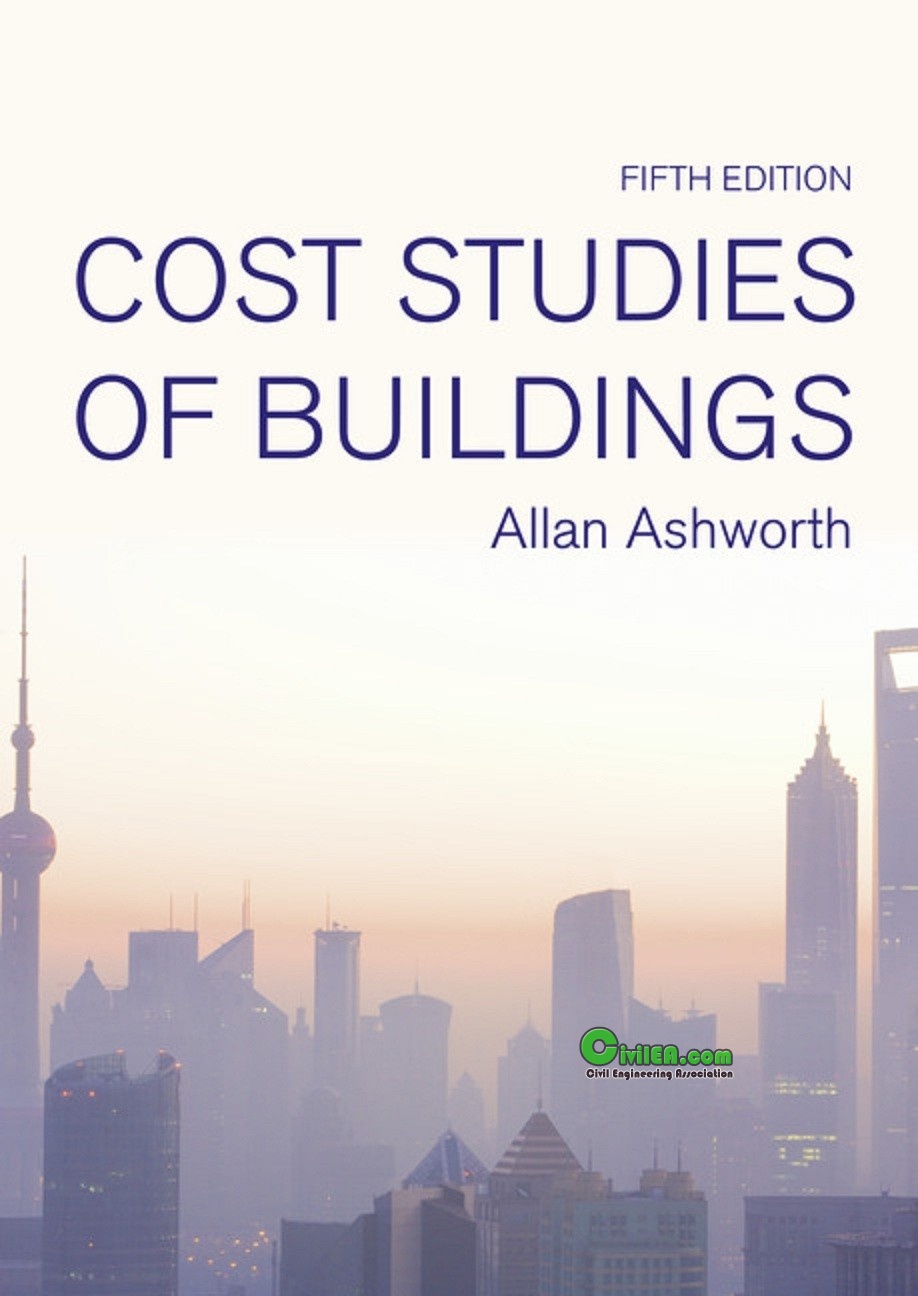
This practical guide to cost studies of buildings has been updated and revised throughout for the 5th edition. New chapters have been added on the RICS New Rules of Measurement (NRM) for order of cost estimating and elemental cost planning, and on the procurement of construction projects.
Code:
Content of this section is hidden, You must be registered and upgrade your account to see this content.
🔽🔽🔽🔽🔽🔽🔽🔽🔽
See this link to read how you can remove this limitation:
👉 CLICK HERE 👈
[MIRROR]Content of this section is hidden, You must be registered and upgrade your account to see this content.
[/MIRROR] 🔽🔽🔽🔽🔽🔽🔽🔽🔽
See this link to read how you can remove this limitation:
👉 CLICK HERE 👈
Code:
Content of this section is hidden, You must be registered and upgrade your account to see this content.
🔽🔽🔽🔽🔽🔽🔽🔽🔽
See this link to read how you can remove this limitation:
👉 CLICK HERE 👈