Size: 2 MB | Format:PDF | Quality:Unspecified | Publisher: FIB - The International Federation for Structural Concrete (fédération internationale du béton) | Year: 2002 | Pages: 35 | ISBN: 9782883940581
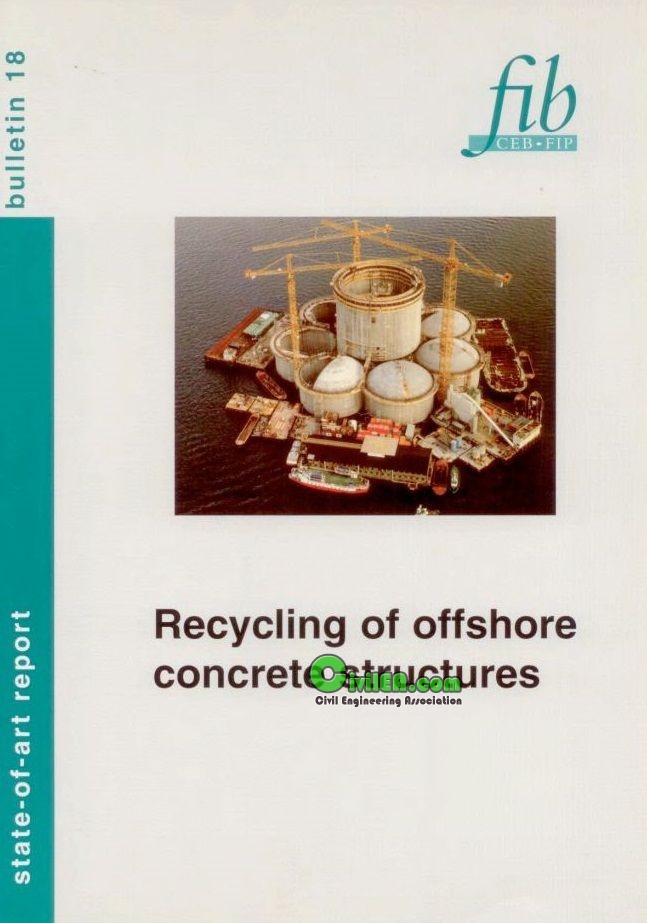
The report confirms that removal, re-use wholly or in part, and complete demolition and recycling of CGS (Concrete Gravity Structures) are technically feasible.
Governmental policy is consistently moving towards rewarding those industries that contribute to environmentally friendly management. Recycled material is an environmentally friendly alternative that incurs reduced consumption of virgin material and less waste disposal. There is no reason to believe that offshore concrete should be less suitable for recycling than other concrete.
For some platforms the most suitable vessel for carrying the topside ashore may prove to be the CGS itself, as it has to be removed from its position anyhow. A successful removal, however, requires a well planned and controlled operation, necessitating a profound knowledge and understanding of the structure, both in its technical and operational aspects. An important instrument to acquire such knowledge are the records kept during the platform's history describing the main parameters and events.
The report treats the aspects of re-use, removal, demolition methods and recycling of materials and refers to all known international and national regulations in this field, adding a comprehensive list of references and usable internet links.
Code:
Content of this section is hidden, You must be registered and upgrade your account to see this content.
🔽🔽🔽🔽🔽🔽🔽🔽🔽
See this link to read how you can remove this limitation:
👉 CLICK HERE 👈
Code:
Content of this section is hidden, You must be registered and upgrade your account to see this content.
🔽🔽🔽🔽🔽🔽🔽🔽🔽
See this link to read how you can remove this limitation:
👉 CLICK HERE 👈
Code:
Content of this section is hidden, You must be registered and upgrade your account to see this content.
🔽🔽🔽🔽🔽🔽🔽🔽🔽
See this link to read how you can remove this limitation:
👉 CLICK HERE 👈
Author: William J. Terrell | Size: 4 MB | Format:PDF | Quality:Unspecified | Publisher: Princeton University Press | Year: 2009 | pages: 480 | ISBN: 0691134448, 9780691134444
Stability and Stabilization is the first intermediate-level textbook that covers stability and stabilization of equilibria for both linear and nonlinear time-invariant systems of ordinary differential equations. Designed for advanced undergraduates and beginning graduate students in the sciences, engineering, and mathematics, the book takes a unique modern approach that bridges the gap between linear and nonlinear systems.
Presenting stability and stabilization of equilibria as a core problem of mathematical control theory, the book emphasizes the subject's mathematical coherence and unity, and it introduces and develops many of the core concepts of systems and control theory. There are five chapters on linear systems and nine chapters on nonlinear systems; an introductory chapter; a mathematical background chapter; a short final chapter on further reading; and appendixes on basic analysis, ordinary differential equations, manifolds and the Frobenius theorem, and comparison functions and their use in differential equations. The introduction to linear system theory presents the full framework of basic state-space theory, providing just enough detail to prepare students for the material on nonlinear systems.
Focuses on stability and feedback stabilization
Bridges the gap between linear and nonlinear systems for advanced undergraduates and beginning graduate students
Balances coverage of linear and nonlinear systems
Covers cascade systems
Includes many examples and exercises
Code:
Content of this section is hidden, You must be registered and upgrade your account to see this content.
🔽🔽🔽🔽🔽🔽🔽🔽🔽
See this link to read how you can remove this limitation:
👉 CLICK HERE 👈
FIB 17: Management, maintenance and strengthening of concrete structures
Size: 2 MB | Format:PDF | Quality:Unspecified | Publisher: FIB - The International Federation for Structural Concrete (fédération internationale du béton) | Year: 2002 | Pages: 174 | ISBN: 9782883940574
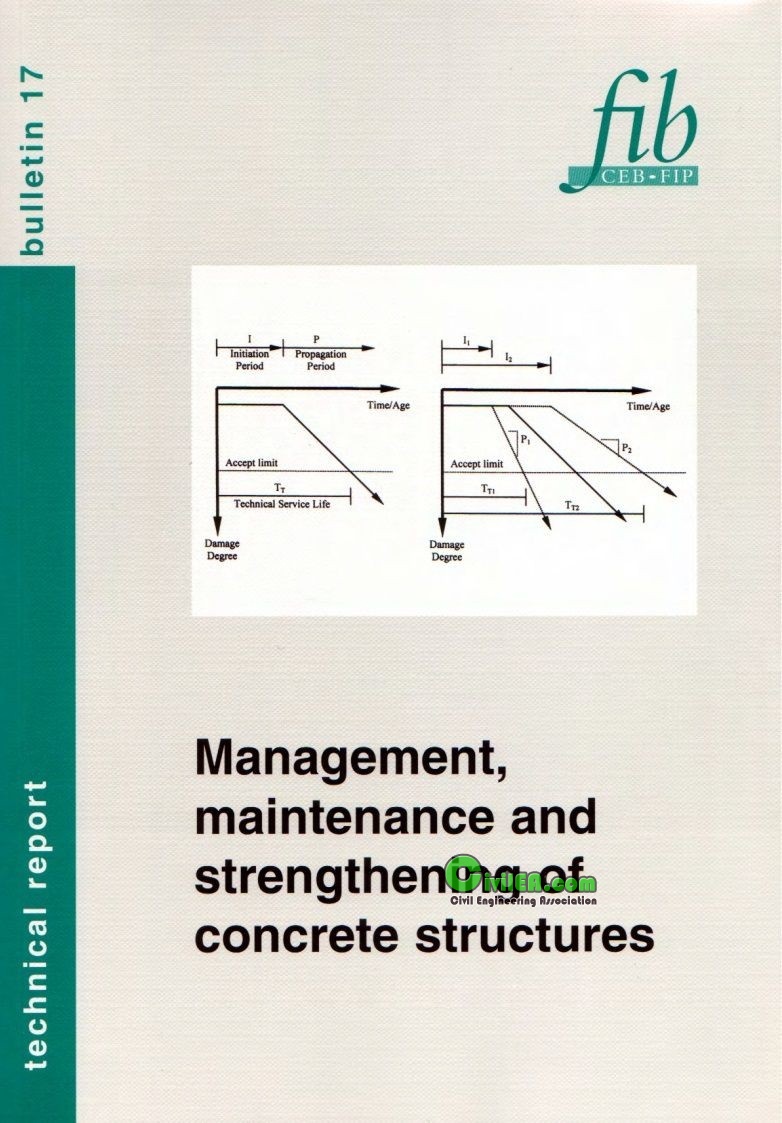
The purpose of this report is twofold. Firstly, to give an overview of the issues relating to the management of concrete structures in general and, secondly, to supplement this with details on items concerned with assessment and remedial actions, as these are important technical parts of management and maintenance systems. The more general aspects of asset management are dealt with here in chapter 1 which is mainly aimed at owners and decisionmakers. Chapters 2 and 3 concern the information required for decision making in the assessment process and are aimed more at consultants and contractors. A review of remediation techniques is given in chapter 3 which is intended to assist in the selection of remedial actions rather than their execution. The report also includes some significant appendices regarding load testing, monitoring, fire and last but not least concerning special considerations relating to seismic retrofitting.
Code:
Content of this section is hidden, You must be registered and upgrade your account to see this content.
🔽🔽🔽🔽🔽🔽🔽🔽🔽
See this link to read how you can remove this limitation:
👉 CLICK HERE 👈
Code:
Content of this section is hidden, You must be registered and upgrade your account to see this content.
🔽🔽🔽🔽🔽🔽🔽🔽🔽
See this link to read how you can remove this limitation:
👉 CLICK HERE 👈
Code:
Content of this section is hidden, You must be registered and upgrade your account to see this content.
🔽🔽🔽🔽🔽🔽🔽🔽🔽
See this link to read how you can remove this limitation:
👉 CLICK HERE 👈
FIB 16: Design examples for the 1996 FIP recommendations Practical design of structural concrete
Size: 8 MB | Format:PDF | Quality:Unspecified | Publisher: FIB - The International Federation for Structural Concrete (fédération internationale du béton) | Year: 2002 | Pages: 193 | ISBN: 9782883940567
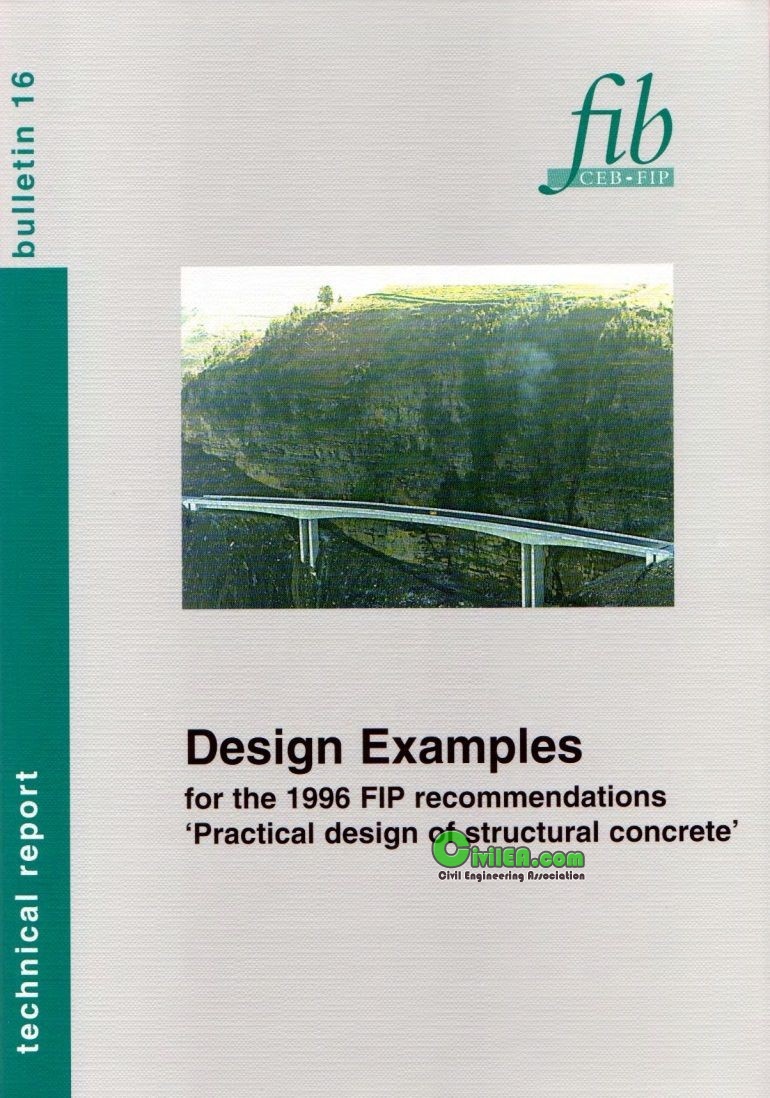
The 1996 FIP Recommendations Practical Design of Structural Concrete were finally published by SETO in September 1999. They had been developed based on the 1990 CEB-FIP Model Code.
The main objective of this Bulletin is now to demonstrate by practical examples the application of these recommendations, and especially to illustrate the use of strut-and-tie models for designing discontinuity regions in concrete structures. These examples represent also a continuation of the 1990 FIP Handbook on Practical Design that had been based on the former (1984) version of the recommendations. Most of the examples are recently built existing structures. Although some of them may be considered as quite important, the chosen examples are by no means exceptional.
The technical report does not deal with the discussion of aesthetic or general conceptual aspects. On the contrary, the main aim is to treat particular design aspects by selecting local regions of the chosen structures, that are then designed and detailed following the design principles and specifications proposed in the 1996 FIP Recommendations mentioned above.
Code:
Content of this section is hidden, You must be registered and upgrade your account to see this content.
🔽🔽🔽🔽🔽🔽🔽🔽🔽
See this link to read how you can remove this limitation:
👉 CLICK HERE 👈
Code:
Content of this section is hidden, You must be registered and upgrade your account to see this content.
🔽🔽🔽🔽🔽🔽🔽🔽🔽
See this link to read how you can remove this limitation:
👉 CLICK HERE 👈
Code:
Content of this section is hidden, You must be registered and upgrade your account to see this content.
🔽🔽🔽🔽🔽🔽🔽🔽🔽
See this link to read how you can remove this limitation:
👉 CLICK HERE 👈
Size: 17 MB | Format:PDF | Quality:Unspecified | Publisher: FIB - The International Federation for Structural Concrete (fédération internationale du béton) | Year: 2001 | Pages: 279 | ISBN: 9782883940550
The 1996 FIP Recommendations Practical Design of Structural Concrete were finally published by SETO in September 1999. They had been developed based on the 1990 CEB-FIP Model Code.
The main objective of this Bulletin is now to demonstrate by practical examples the application of these recommendations, and especially to illustrate the use of strut-and-tie models for designing discontinuity regions in concrete structures. These examples represent also a continuation of the 1990 FIP Handbook on Practical Design that had been based on the former (1984) version of the recommendations. Most of the examples are recently built existing structures. Although some of them may be considered as quite important, the chosen examples are by no means exceptional.
The technical report does not deal with the discussion of aesthetic or general conceptual aspects. On the contrary, the main aim is to treat particular design aspects by selecting local regions of the chosen structures, that are then designed and detailed following the design principles and specifications proposed in the 1996 FIP Recommendations mentioned above.
Code:
Content of this section is hidden, You must be registered and upgrade your account to see this content.
🔽🔽🔽🔽🔽🔽🔽🔽🔽
See this link to read how you can remove this limitation:
👉 CLICK HERE 👈
Code:
Content of this section is hidden, You must be registered and upgrade your account to see this content.
🔽🔽🔽🔽🔽🔽🔽🔽🔽
See this link to read how you can remove this limitation:
👉 CLICK HERE 👈
Code:
Content of this section is hidden, You must be registered and upgrade your account to see this content.
🔽🔽🔽🔽🔽🔽🔽🔽🔽
See this link to read how you can remove this limitation:
👉 CLICK HERE 👈
Author: John K Hunter | Size: 6 MB | Format:PDF | Quality:Unspecified | Publisher: World Scientific | Year: 2001 | pages: 439 | ISBN: 9810241917, 9789810241919, 9812705430, 9789812705433
This book provides an introduction to those parts of analysis that are most useful in applications for graduate students. The material is selected for use in applied problems, and is presented clearly and simply but without sacrificing mathematical rigor.
The text is accessible to students from a wide variety of backgrounds, including undergraduate students entering applied mathematics from non-mathematical fields and graduate students in the sciences and engineering who want to learn analysis. A basic background in calculus, linear algebra and ordinary differential equations, as well as some familiarity with functions and sets, should be sufficient.
Readership: Graduate students in applied analysis.
Code:
Content of this section is hidden, You must be registered and upgrade your account to see this content.
🔽🔽🔽🔽🔽🔽🔽🔽🔽
See this link to read how you can remove this limitation:
👉 CLICK HERE 👈
Without doubt, active corrosion protection of prestressing steels by cement grout can be one of the most economic and durable solutions, if properly executed. Numerous other corrosion protection systems which fulfill requirements such as controllability and exchangeability are available. This state-of-art report, prepared by a Task Group and approved by fib Commission 9 Reinforcing and prestressing materials and systems, concentrates exclusively on factory applied corrosion protection that can be produced in controlled processes which should assure a better quality than corrosion protection applied on site. The report is addressed to designers and installers (executing persons) attempting to inform them about the various possibilities for industrially applied corrosion protection and to provide the necessary knowledge for their application.
Code:
Content of this section is hidden, You must be registered and upgrade your account to see this content.
🔽🔽🔽🔽🔽🔽🔽🔽🔽
See this link to read how you can remove this limitation:
👉 CLICK HERE 👈