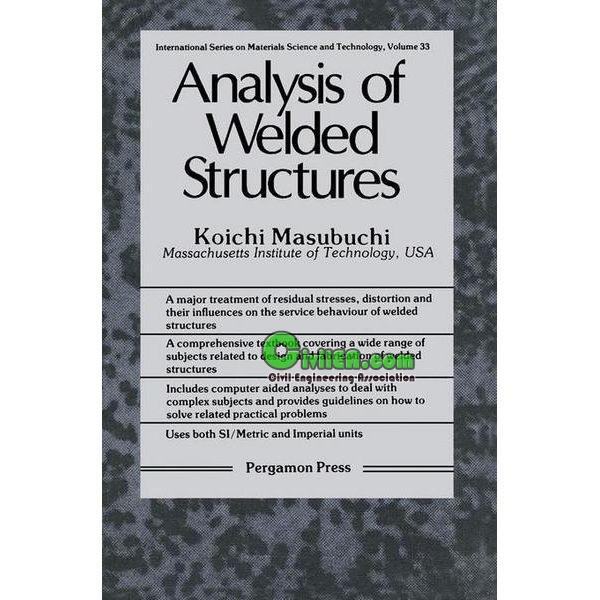
Analysis of Welded Structures: Residual Stresses, Distortion, and their Consequences encompasses several topics related to design and fabrication of welded structures, particularly residual stresses and distortion, as well as their consequences. This book first introduces the subject by presenting the advantages and disadvantages of welded structures, as well as the historical overview of the topic and predicted trends. Then, this text considers residual stresses, heat flow, distortion, fracture toughness, and brittle and fatigue fractures of weldments. This selection concludes by discussing the effects of distortion and residual stresses on buckling strength of welded structures and effects of weld defects on service behavior. This book also provides supplementary discussions on some related and selected subjects. This text will be invaluable to metallurgists, welders, and students of metallurgy and welding.
Code:
Content of this section is hidden, You must be registered and upgrade your account to see this content.
🔽🔽🔽🔽🔽🔽🔽🔽🔽
See this link to read how you can remove this limitation:
👉 CLICK HERE 👈
- General quadrilateral meshing of floor areas.
- User-defined internal mesh for shells.
- Improved merging of floor areas by removing common edges.
- Ability to automatically add rigid-zone areas over columns and walls.
- Improved DirectX Display.
- New link property to represent high-damping rubber-bearing isolator.
- Multiple controlled displacements for static pushover analysis.
- Link properties can be used for line and area springs.
- Strain response for shell objects (walls and floors).
- Option to control the slope of steep strength-drop in frame hinges.
- Improved convergence behavior for displacement-controlled nonlinear static load cases.
- Non-iterative event-to-event option for nonlinear static analysis.
- Increased speed and reduced storage for running and displaying results of nonlinear load cases.
- ASCE 41-17 auto hinges.
- Optional points BC and CD on hinge backbone curves.
- Auto-wind loading according to the ASCE 7-16 code and Korean Building Code (KBC 2016) added.
- Auto-seismic loading according to the ASCE 7-16 code, Korean Building Code (KBC 2016), Indian Standard Code (IS 1893:2016) and Turkish Seismic Code (TSC-2018) added.
- Automated response spectrum functions according to the ASCE 7-16, Korean Building Code (KBC 2016), Indian Standard (IS 1893:2016) and Turkish Seismic Code (TSC-2018) added.
- AISC 360-16 composite beam design added.
- AISC 360-16 steel frame design added.
- NTC 2018 Steel Frame Design added.
- IS 456:2000 concrete frame design updated for the IS 13920:2016 seismic code.
- Parallel processing has been implemented for running design (all types).
- Automatic concrete column design to achieve strong-column/weak-beam connections.
- Implementation of AISC Design Guide (DG) 11 for composite beam design based on AISC 360, CSA S16 and Eurocode.
- Web penetrations for composite beam design based on AISC 360-16, AISC 36-10 and AISC 360-05 codes.
Code:
Content of this section is hidden, You must be registered and upgrade your account to see this content.
🔽🔽🔽🔽🔽🔽🔽🔽🔽
See this link to read how you can remove this limitation:
👉 CLICK HERE 👈
Code:
Content of this section is hidden, You must be registered and upgrade your account to see this content.
🔽🔽🔽🔽🔽🔽🔽🔽🔽
See this link to read how you can remove this limitation:
👉 CLICK HERE 👈
Private Note:
ETABS v17.0.0 Enhancements:
Code:
Content of this section is hidden, You must be registered and upgrade your account to see this content.
🔽🔽🔽🔽🔽🔽🔽🔽🔽
See this link to read how you can remove this limitation:
👉 CLICK HERE 👈
Code:
Content of this section is hidden, You must be registered and upgrade your account to see this content.
🔽🔽🔽🔽🔽🔽🔽🔽🔽
See this link to read how you can remove this limitation:
👉 CLICK HERE 👈
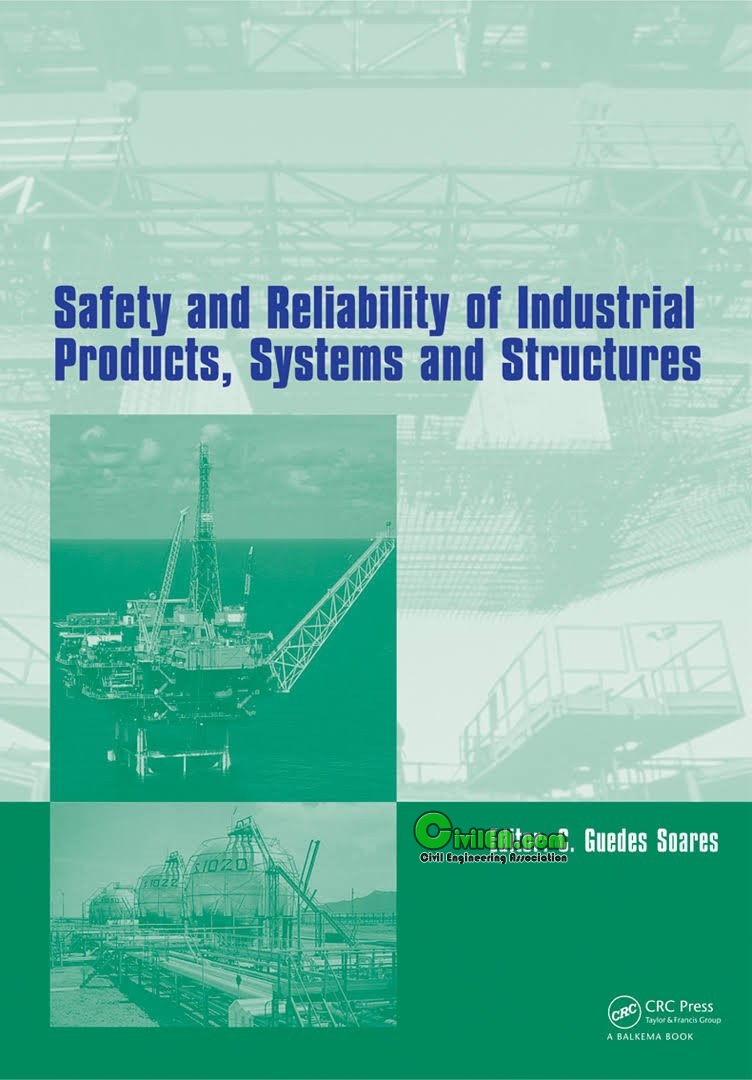
Includes contributions from experts in the area of risk assessment; special focus on safety-critical systems in all types of industrial plants, equipment, structural systems, buildings and other civil engineering facilities; must-have information for academia and engineers involved in industrial safety, structural reliability, quantified risk assessment and safety management.
Code:
Content of this section is hidden, You must be registered and upgrade your account to see this content.
🔽🔽🔽🔽🔽🔽🔽🔽🔽
See this link to read how you can remove this limitation:
👉 CLICK HERE 👈
This practical and comprehensive book enables the engineer to diagnose the cause of a fault, choose the appropriate remedial technique and ensure that the repair work is completed satisfactorily. It will be of value to all those who need to commission, supervise or carry out repairs to concrete structures.
Code:
Content of this section is hidden, You must be registered and upgrade your account to see this content.
🔽🔽🔽🔽🔽🔽🔽🔽🔽
See this link to read how you can remove this limitation:
👉 CLICK HERE 👈