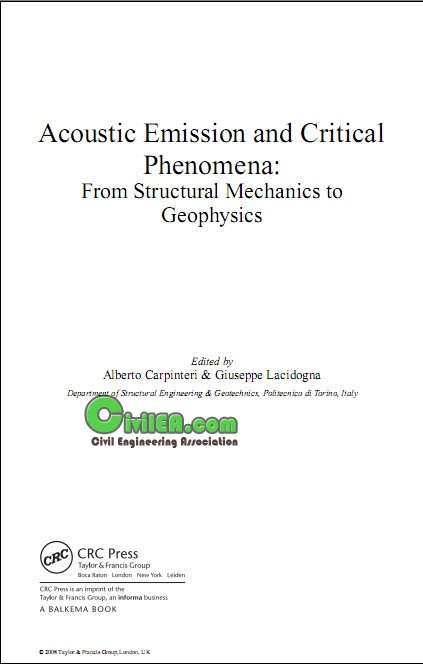
Acoustic Emission and Critical Phenomena: From Structural Mechanics to Geophysics
A. Carpinteri, Giuseppe Lacidogna, "Acoustic Emission and Critical Phenomena: From Structural Mechanics to Geophysics"
Taylor & Francis, Inc. | 2008 | ISBN: 0203892224, 0415450829 | 336 pages | PDF | 22,1 MB
The Acoustic Emission (AE) technique uses ad hoc transducers to detect AE events caused by crack growth in structures under external loading. This technique is similar to the one employed in earthquake control, where seismic waves reach the monitoring stations placed on the surface of the Earth. And although they take place on different scales, these two phenomena – damage in structural materials and earthquakes in geophysics – are very similar. In both cases a release of elastic energy from sources located inside a medium occurs.
Both earthquakes and AE signals can be seen as critical phenomena and follow the Guttenberg-Richter frequency-magnitude relationship under a wide variety of conditions. The number of earthquakes and AE signals scale as a power-law of the area of the rupture zone, where fractal scaling is proposed for the spatial and temporal distributions of earthquakes and AEs. In addition, earthquakes can be taken as an example of the notion of self-organized criticality, since this idea describes the spontaneous organization of the dynamics of a system towards a very particular state, analogous to the critical point found in equilibrium phase transitions. It is also pointed out that brittle failure phenomena, as identified through AE monitoring in concrete, masonry and rocks, can be considered as critical phenomena.
This volume includes contributions from internationally recognized experts in the areas of seismicity and acoustic emission, presented at the Post-Conference Workshop on “Acoustic Emission and Critical Phenomena: From Structural Mechanics to Geophysics” (Catania, Italy, 22 June 2007) during the 6th International Conference on Fracture Mechanics of Concrete and Concrete Structures (FraMCoS-6). Acoustic Emission and Critical Phenomena: From Structural Mechanics to Geophysics is divided into two parts: Acoustic Emission and Critical Structural States (Part 1), and Seismic Mechanics and Critical Behaviours (Part 2). The book brings together the state-of-the-art in areas ranging from the mechanics of materials to geophysics, and outlines the potential of the AE technique in terms of practical applications (non-destructive testing and failure evaluation) and theoretical developments (critical phenomena in complex systems). The book will proof to be invaluable to civil and geotechnical engineers, and to researchers working in the areas of mechanics of materials, geophysics, and nondestructive measurements and testing.
Code:
Content of this section is hidden, You must be registered and upgrade your account to see this content.
🔽🔽🔽🔽🔽🔽🔽🔽🔽
See this link to read how you can remove this limitation:
👉 CLICK HERE 👈
Code:
Content of this section is hidden, You must be registered and upgrade your account to see this content.
🔽🔽🔽🔽🔽🔽🔽🔽🔽
See this link to read how you can remove this limitation:
👉 CLICK HERE 👈
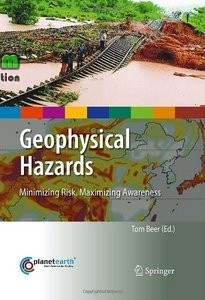
This volume, written by the Hazards Science Team of the International Year of Planet Earth, brings together some of the most influential international scientists dealing with Natural Hazards and Society’s response to natural hazards. It recognises that hazards, like poverty, will always be with us but that concerted and organised societal response can prevent a hazard becoming a disaster. By bringing together geoscientists, social scientists and those concerned with the administration of international science and international disaster reduction, this book details the state-of-the-science as well as the state-of-the-response in natural hazards.
The contents of this volume fall into four parts:
Part 1 deals with the IYPE Hazards Theme and its relation to society, emphasising that implementation of the Hyogo Framework for Action requires a strong emphasis on human societies, human security, and that this can be achieved only through appropriate communication. Part 2 focuses on the response of the international scientific community. Part 3 concentrates on geophysical risk and sustainability by considering climate and climate change as well as the theory and the praxis involved in hazards, their prevention and mitigation. Part 4 relates to the observation and assessment of geo-hazards and risk.
Code:
Content of this section is hidden, You must be registered and upgrade your account to see this content.
🔽🔽🔽🔽🔽🔽🔽🔽🔽
See this link to read how you can remove this limitation:
👉 CLICK HERE 👈
Code:
Content of this section is hidden, You must be registered and upgrade your account to see this content.
🔽🔽🔽🔽🔽🔽🔽🔽🔽
See this link to read how you can remove this limitation:
👉 CLICK HERE 👈
Numerical Methods In Geotechnical Engineering - NUMGE 2010
Hardcover: 976 pages
Publisher: CRC Press; 1 edition (25 May 2010)
Language English
ISBN-10: 0415592399
ISBN-13: 978-0415592390
Numerical Methods in Geotechnical Engineering contains 153 scientific papers presented at the 7th European Conference on Numerical Methods in Geotechnical Engineering, NUMGE 2010, held at Norwegian University of Science and Technology (NTNU) in Trondheim, Norway, 2–4 June 2010.
The contributions cover topics from emerging research to engineering practice, and are organized into the following sections:
- Constitutive modeling;
- Computer codes and algorithms;
- Discontinuum and particulate modeling;
- Large deformation – large strain analysis;
- Flow and consolidation;
- Unsaturated soil mechanics;
- Artificial intelligence;
- Reliability and probability analysis;
- Dynamic problems and Geohazards;
- Slopes and cuts;
- Embankments, shallow foundations, and settlements;
- Piles;
- Deep excavations and retaining walls;
- Tunnels and caverns;
- Ground improvement modeling;
- Offshore geotechnical engineering;
- Numerical methods and Eurocode.
Code:
Content of this section is hidden, You must be registered and upgrade your account to see this content.
🔽🔽🔽🔽🔽🔽🔽🔽🔽
See this link to read how you can remove this limitation:
👉 CLICK HERE 👈
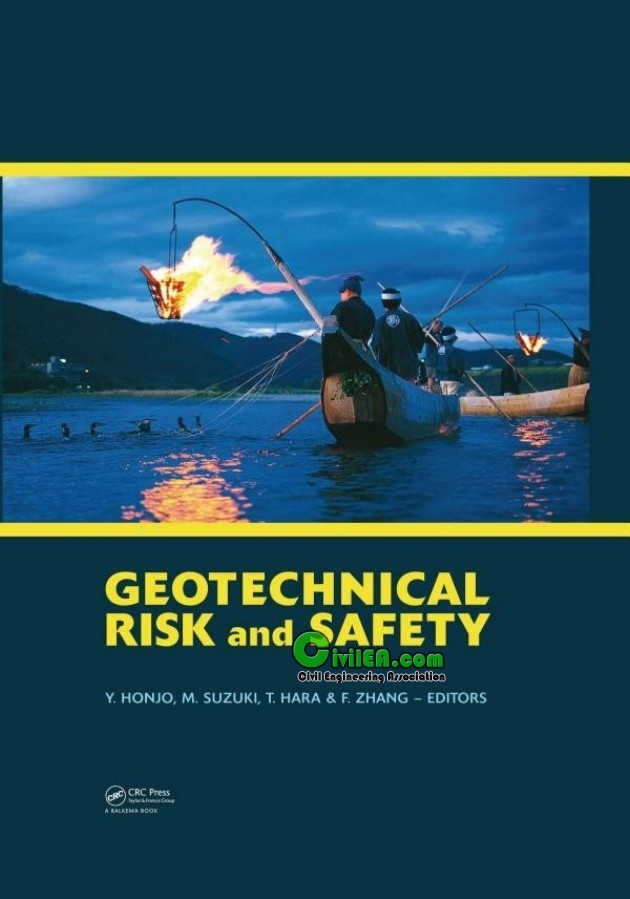
Geotechnical Risk and Safety
Proceedings of the 2nd International Symposium on Geotechnical Safety and Risk
(IS-Gifu 2009) 11-12 June, 2009, Gifu, Japan - IS-Gifu2009
Edited by Yusuke Honjo, Makoto Suzuki, Takashi Hara, Feng Zhang
Description
Communication of risks within a transparent and accountable framework is essential in view of increasing mobility and the complexity of the modern society and the field of geotechnical engineering does not form an exception. As a result, modern risk assessment and management are required in all aspects of geotechnical issues, such as planning, design, construction of geotechnical structures, mitigation of geo-hazards, management of large construction projects, maintenance of structures and life-cycle cost evaluation. This volume discusses: 1. Evaluation and control of uncertainties through investigation, design and construction of geotechnical structures; 2. Performance-based specifications, reliability based design and limit state design of geotechnical structures, and design code developments; 3. Risk assessment and management of geo-hazards, such as landslides, earthquakes, debris flow, etc.; 4. Risk management issues concerning large geotechnical construction projects; 5. Repair and maintenance strategies of geotechnical structures. Intended for researchers and practitioners in geotechnical, geological, infrastructure and construction engineering.
Code:
Content of this section is hidden, You must be registered and upgrade your account to see this content.
🔽🔽🔽🔽🔽🔽🔽🔽🔽
See this link to read how you can remove this limitation:
👉 CLICK HERE 👈
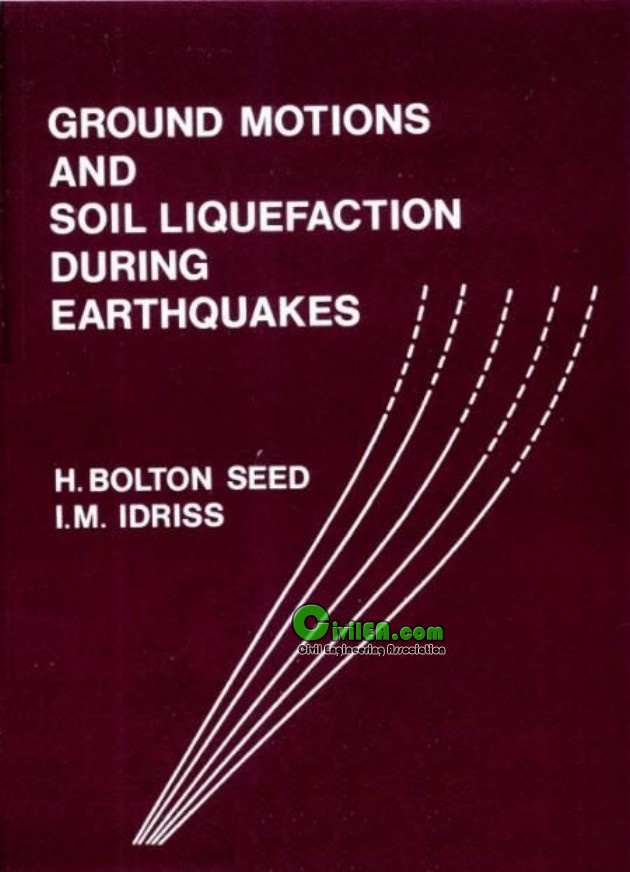
Ground Motions and Soil Liquefaction During Earthquakes - Seed & Idriss
This book is one of the few classic books published by the Earthquake Engineering Institute in California authored by Seed and Idriss considered to be the persons who gave us a logical explanation in the mechanics of soil liquefaction. The book introduces the basic understanding of soil liquefaction good for junior engineers and a review for senior engineers.
Published 1982
No. of pages 134
File pdf size 5049 kb
Cheers
Jpver
Code:
Content of this section is hidden, You must be registered and upgrade your account to see this content.
🔽🔽🔽🔽🔽🔽🔽🔽🔽
See this link to read how you can remove this limitation:
👉 CLICK HERE 👈
I am having problem analysis a 600 x 600 x 10 mm plate in staad. with only self wt the stress are so high. I am attaching the staad input file, please check and inform what i am doing wrong.
The plate is intended to be a chequered plate cover over underground Pit.
Staad Plate
Code:
Content of this section is hidden, You must be registered and upgrade your account to see this content.
🔽🔽🔽🔽🔽🔽🔽🔽🔽
See this link to read how you can remove this limitation:
👉 CLICK HERE 👈
i need the folowing standards
BS EN ISO 22476-2:2005
BS EN ISO 14688-1:2002
BS EN ISO 14688-2:2004
BS EN ISO 22476-3:2005
DD CEN ISO/TS 17892-6:2004
ASTM D2488-09a
ASTM D1452-09
ASTM D4829-08a
or any standard about soil mechanics identification or lab testing, site testing,
i have eurocode 7
107-s37 Performance of Retrofit Highway Barriers with Mechanical Anchors
107-s38 Nonlinear Analysis of Cross Sections under Axial Load and Biaxial Bending
107-s39 Analytical Modeling of Medium-Rise Reinforced Concrete Shear Walls
107-s40 Smeared Rotating Crack Model for Reinforced Concrete Membrane Elements
107-s41 Shear-Transfer Strength of Reinforced Concrete
107-s42 Seismic Design of Reinforced Concrete Bridge Columns at Subfreezing Temperatures
107-s43 Strengthening of Flat Slabs Against Punching Shear Using Post-Installed Shear Reinforcement
107-s44 Shear Behavior of Externally Prestressed Beams with Carbon Fiber-Reinforced Polymer Tendons
107-s45 Ultimate Strength of Reinforced Concrete Beams Retrofitted with Hybrid Bonded Fiber-Reinforced Polymer
107-s46 Transverse Resistance of Masonry Infills
107-s47 Punching Shear Behavior of Two-Way Slabs Reinforced with High-Strength Steel
107-s48 Compression Splices in Confined Concrete of 40 and 60 MPa (5800 and 8700 psi) Compressive Strengths
d107-s04 Five Discussions from the September/October 2009 ACI Structural Journal
Code:
Content of this section is hidden, You must be registered and upgrade your account to see this content.
🔽🔽🔽🔽🔽🔽🔽🔽🔽
See this link to read how you can remove this limitation:
👉 CLICK HERE 👈
Code:
Content of this section is hidden, You must be registered and upgrade your account to see this content.
🔽🔽🔽🔽🔽🔽🔽🔽🔽
See this link to read how you can remove this limitation:
👉 CLICK HERE 👈