Has anyone in mind any books or sites that might have examples for euro-code 9 ?
There are some parts of the code that, i believe are not that clear...
so some sort of book with solved examples of aluminium structures would be helpful...
SUMMARY OF CONCRETE WORKABILITY TEST METHODS
Eric P. Koehler
University of Texas at Austin
Austin, TX
David W. Fowler
University of Texas at Austin
Austin, TX
ICAR Report 105.1
ICAR 105: Measuring the Workability of High Fines Concrete
Sponsored by:
Aggregates Foundation for Technology, Research, and Education
International Center for Aggregates Research
The University of Texas at Austin
August 2003
This document describes 61 test methods for measuring concrete workability.
Many more test methods have been developed for a single project or for a specific
application and have been sparsely reported in the literature, if at all. Although many of
the devices in this document will likely never be used in the future and have been
scarcely used in the past, an examination of tests that have failed and tests that have
been supplanted by better tests is instructive in recognizing trends in concrete
workability research and in selecting key concepts for the development of a new test
method.
This document first describes key principles and trends in the measurement of
workability and then describes the 61 test methods. Based on the successes and failures
of past test methods and the current needs of the concrete industry, requirements for
new test methods are developed.
Code:
Content of this section is hidden, You must be registered and upgrade your account to see this content.
🔽🔽🔽🔽🔽🔽🔽🔽🔽
See this link to read how you can remove this limitation:
👉 CLICK HERE 👈
Code:
Content of this section is hidden, You must be registered and upgrade your account to see this content.
🔽🔽🔽🔽🔽🔽🔽🔽🔽
See this link to read how you can remove this limitation:
👉 CLICK HERE 👈
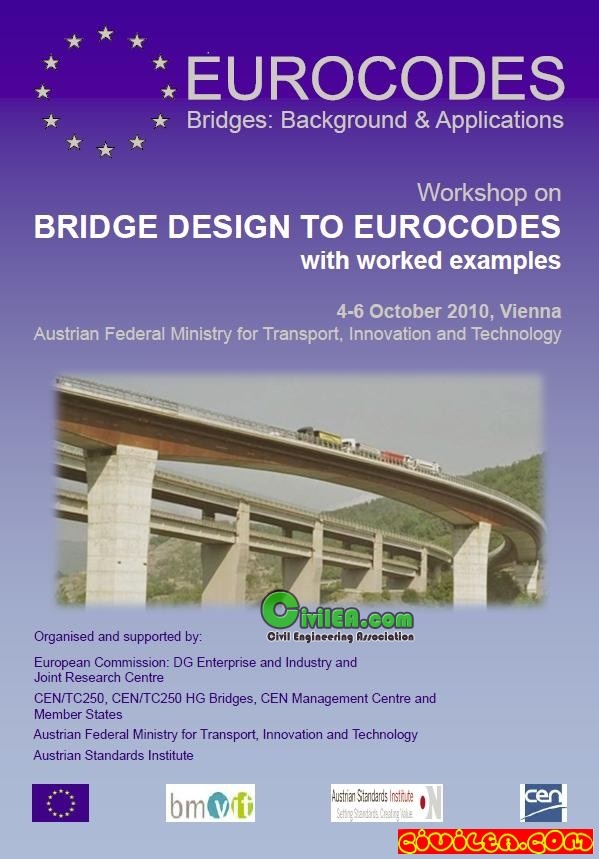
The workshop on "Bridge Design to Eurocodes" with worked examples was held on October 4-6, 2010 in the Austrian Federal Ministry for Transport, Innovation and Technology in Vienna. This workshop was the first training event organised at European level for the design of bridges using the Eurocodes. The workshop was organised by Joint Research Centre, CEN/TC210 Horizontal Group Bridges and the Austrian Federal Ministry for Transport, Innovation and Technology and supported by the European Commission DG Enterprise and Industry, CEN/TC250, CEN Management Centre, the Member States and the Austrian Standards Institute. Opening addresses were delivered by Peter Franzmayr, Austrian Deputy Minister for Transport, Innovation and Technology, Manfred Fuchs, European Commission DG Enterprise, Jean-Armand Calgaro, CEN/TC 250 Chairman and Artur Pinto, Joint Research Center.
Objectives
This workshop with emphasis on worked examples contributed towards transfer of background knowledge and expertise of Eurocode Bridge Parts writers (CEN/TC250 Horizontal Group Bridges) to potential trainers at national level and Eurocode users.
The principal objectives of the workshop are to:
-transfer knowledge and information to representatives of key organisations/institutions,
industry and technical associations in Member States;
-provide state-of-the-art training material, background information and worked examples to Eurocodes trainers and users;
-facilitate exchange of views, networking and cooperation.
Code:
Content of this section is hidden, You must be registered and upgrade your account to see this content.
🔽🔽🔽🔽🔽🔽🔽🔽🔽
See this link to read how you can remove this limitation:
👉 CLICK HERE 👈
EN ISO 15630, part 1, 2 and 3:2002 Steel for the reinforcement and prestressing of concrete - Test methods
EN ISO 15630-1 - Steel for the reinforcement and prestressing of concrete - Test methods - Part 1: Reinforcing bars, wire rod and wire (ISO 15630-1:2002)
This part of ISO 15630 specifies test methods applicable to reinforcing bars, wire rod and wire.
EN ISO 15630-2 - Steel for the reinforcement and prestressing of concrete - Test methods - Part 2: Welded fabric (ISO 15630-2:2002)
This part of ISO 15630 specifies test methods applicable to welded fabric.
EN ISO 15630-3 - Steel for the reinforcement and prestressing of concrete - Test methods - Part 3: Prestressing steel (ISO 15630-3:2002)
This part of ISO 15630 specifies test methods applicable to prestressing steels (bar, wire or strand).
Code:
Content of this section is hidden, You must be registered and upgrade your account to see this content.
🔽🔽🔽🔽🔽🔽🔽🔽🔽
See this link to read how you can remove this limitation:
👉 CLICK HERE 👈
Code:
Content of this section is hidden, You must be registered and upgrade your account to see this content.
🔽🔽🔽🔽🔽🔽🔽🔽🔽
See this link to read how you can remove this limitation:
👉 CLICK HERE 👈
Studies of the Physical Properties of Hardened Portland Cement Paste
Studies of the Physical Properties of Hardened Portland Cement Paste
Author(s): T. C. Powers and T. L. Brownyard
Publication: Journal Proceedings
Volume: 43
Issue: 9
Pages: 933-992
Keywords: none
Date: April 1, 1947
In nine parts, Part 1. A Review of Methods That Have Been Used for Studying the Physical Properties of Hardened Portland Cement Paste Part 2. Studies of Water Fixation Appendix to Part 2 Part 3. Theoretical interpretation of Adsorption Data Part 4. Thermodynamics of adsorption Appendix to Parts 3 and 4 Part 5. Studies of the Hardened Paste by Means of Specific-Volume Measurements Part 6. Relation of Physical Characteristics of the Paste to Compressive Strength Part 7. Permeability and Absorptivity Part 8. The Freezing of Water in Hardened Portland Cement Paste Part 9. General Summary of Findings on the Properties of Hardened Portland Cement Paste This paper deals mainly with data on water fixation in hardened portland cement paste, the properties of evaporable water, the density of the solid substance and the porosity of the paste as a whole. The studies of the evaporable water include water-vapor-adsorp- tion characteristics and the thermodynamics of ad- sorption. The discussions include the following topics: I. Theoretical interpretation of adsorption data 2. The specific surface of hardened portland ce- ment paste. 3. Minimum porosity of hardened paste 4. Relative amounts of gel-water and capillary 5. The thermodynamics of adsorption 6. The energy of binding of water in hardened paste 7. ‘Swelling pressure 8. Mechanism of shrinking and swelling 9. Capillary-flow and moisture diffusion IO. Estimation of absolute volume of solid phase in hardened paste I I. Soecific volumes of evaporable and nonevap- ora ble water 12. Computation of volume of solid phase in hard- ened ’ paste 13. Limit of hydration of portland cement 14. Relation of physical characteristics of paste to compressive strength 15. Permeability and absorptivity 16. Freezing of water in hardened portland cement paste.
Classics in genre.
There is no need of presentation for these autors.
Code:
Content of this section is hidden, You must be registered and upgrade your account to see this content.
🔽🔽🔽🔽🔽🔽🔽🔽🔽
See this link to read how you can remove this limitation:
👉 CLICK HERE 👈
Code:
Content of this section is hidden, You must be registered and upgrade your account to see this content.
🔽🔽🔽🔽🔽🔽🔽🔽🔽
See this link to read how you can remove this limitation:
👉 CLICK HERE 👈
Corrections for Membrane Strength in the Triaxial Test
Authors: R.H. Kuerbis, Y.P. Vaid
Volume 13, Issue 4 (December 1990)
ISSN: 1945-7545
Page Count: 9
Posted by: ir_71 - 10-22-2010, 12:31 PM - Forum: EN
- No Replies
EN ISO 286:2010 Geometrical product specifications (GPS) - ISO code system for tolerances on linear sizes
EN ISO 286-1:2010 Geometrical product specifications (GPS) - ISO code system for tolerances on linear sizes - Part 1: Basis of tolerances, deviations and fits (ISO 286-1:2010)
This part of ISO 286 establishes the ISO code system for tolerances to be used for linear sizes of features of
the following types:
a) cylinder;
b) two parallel opposite surfaces.
It defines the basic concepts and the related terminology for this code system. It provides a standardized
selection of tolerance classes for general purposes from amongst the numerous possibilities.
Additionally, it defines the basic terminology for fits between two features of size without constraints of
orientation and location and explains the principles of “basic hole” and “basic shaft”.
EN ISO 286-2:2010 Geometrical product specifications (GPS) - ISO code system for tolerances on linear sizes - Part 2: Tables of standard tolerance classes and limit deviations for holes and shafts (ISO 286-2:2010)
This part of ISO 286 gives values of the limit deviations for commonly used tolerance classes for holes and
shafts calculated from the tables given in ISO 286-1. This part of ISO 286 covers values for the upper limit
deviations ES (for holes) and es (for shafts), and the lower limit deviations EI (for holes) and ei (for shafts)
(see Figures 1 and 2).
NOTE In the tables of limit deviations, the values of the upper limit deviation ES or es are shown above the values of
the lower limit deviation EI or ei except for tolerance classes JS and js which are symmetrical about the zero line.
The ISO system for tolerances on linear size provides a system of tolerances and deviations suitable for
features of the following types:
a) cylinders;
b) two parallel opposite surfaces.
For simplicity, and also because of the importance of cylindrical workpieces of circular section, only these are
referred to explicitly. It should be clearly understood, however, that the tolerances and deviations given in this
part of ISO 286 equally apply to workpieces of other than circular sections.
In particular, the term “hole” or “shaft” is used to designate features of the cylinder type (e.g. for the
tolerancing of the diameter of a hole or shaft) and, for simplicity, these terms are also used for two parallel
opposite surfaces (e.g. for the tolerancing of the thickness of a key or the width of a slot).
For further information on terminology, symbols, the basis of the system, etc., see ISO 286-1.
Code:
Content of this section is hidden, You must be registered and upgrade your account to see this content.
🔽🔽🔽🔽🔽🔽🔽🔽🔽
See this link to read how you can remove this limitation:
👉 CLICK HERE 👈
Code:
Content of this section is hidden, You must be registered and upgrade your account to see this content.
🔽🔽🔽🔽🔽🔽🔽🔽🔽
See this link to read how you can remove this limitation:
👉 CLICK HERE 👈
I am looking for a paper for some time but I do not have access to it. If you have access to it please share. The paper is P. Wriggers, S. Reese, Thermoelastic stability of trusses with temperature-dependent constitutive relations, International Journal for Numerical Methods in Engineering 35 (1992), 1891-1906. Thank a lot! Cu