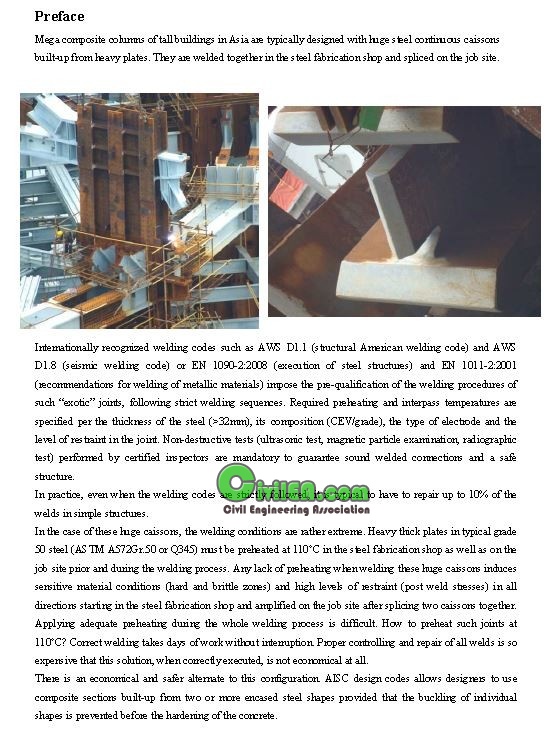
Abstract Composite mega columns of tall buildings are currently designed with continuous built-up sections, welded in the fabrication shop and spliced on the job site without any prequalified welding procedure. This leads to highly restrained welds and splices which, under severe dynamic loadings, will likely crack before exhibiting any ductile behavior. These tall buildings have not been submitted to severe earthquakes, but it will happen. The 1994 earthquake in Northridge, California, taught us that welding procedures, beam-to-column connections and column splices have to be as simple as possible to properly and reliably work as anticipated.
Using multiple rolled sections encased into concrete is the solution for increasing the safety of tall buildings. It leads to less welding, less fabrication works and reliable simple splices which have been used for decades in high-rise projects.
AISC allows engineers to design composite sections built-up from two or more encased steel. But, it doesn’t explain how to perform and check the design. This paper offers a method to do it. The method is explained by means of design examples covering combined axial compression, bending and shear.
Code:
Content of this section is hidden, You must be registered and upgrade your account to see this content.
🔽🔽🔽🔽🔽🔽🔽🔽🔽
See this link to read how you can remove this limitation:
👉 CLICK HERE 👈
1. BS EN ISO 22477-1:2018. Geotechnical investigation and testing. Testing of geotechnical structures. Testing of piles: static compression load testing
2. BS EN ISO 22477-5:2018. Geotechnical investigation and testing. Testing of geotechnical structures. Testing of grouted anchors
3. BS EN ISO 22477-4:2018. Geotechnical investigation and testing. Testing of geotechnical structures. Testing of piles: dynamic load testing
4. BS EN ISO 22477-10:2016. Geotechnical investigation and testing. Testing of geotechnical structures. Testing of piles: rapid load testing
Posted by: lakshman - 02-01-2019, 06:28 AM - Forum: Archive
- No Replies
Hi,
I am looking for a Journal paper written by G. Shailendra and Veeraragavan A "Research need in subsurface drainage for long lasting pavements" Highway Research Journal 2010.
Hi Colleagues:
I am looking for several ISO Standards related to Statistical interpretation and Inspections of Data, Sampling Procedures, QC, etc.
ISO 2394: "General principles on reliability of structures" ISO 2854: "Statistical interpretation of data — Techniques of estimation and tests relating to means and variances" ISO 3207: “Statistical interpretation of data: determination of a statistical tolerance interval.” ISO 3301: "Statistical interpretation of data - Comparison of two means in the case of paired observations" ISO 3534-1: "Statistics — Vocabulary and symbols — Part 1: Probability and general statistical terms." ISO 3534-2: "Statistics — Vocabulary and symbols — Part 2: Statistical quality control" ISO 3951-1: "Sampling procedures for inspection by variables –. Part 1: Specification for single sampling plans indexed by acceptance" ISO 3951-2: "Sampling procedures for inspection by variables –. Part 2: General specification for single sampling..." ISO 5479: "Statistical interpretation of data - Tests for departure from the normal distribution" ISO 12491: "Statistical methods for quality control of building materials and components"
There might be equivalent British Standards to these and that would also be acceptable.
Structural Detailing: For Architecture, Building and Civil Engineering Students
Author(s)/Editor(s): Peter H. Newton | Size: 17.5 MB | Format:PDF | Quality:Unspecified | Publisher: Palgrave Macmillan | Year: 174 | pages: 1991 | ISBN: ISBN-10: 033355471X ISBN-13: 978-0333554715
Structural detailing consists of transforming the work of a structural engineer into working drawings for the use of the builder. The intended reader of this book is young and inexperienced and has not yet mastered bending moments and shearing forces, principal stresses and limit states, areas of steel and equivalent lengths. For this reason the book has been written for the reader with little or no prior knowledge of structural mechanics and simple explanations are given of the behaviour of structural components in service. Similarly it is assumed that the reader will have had little or no site experience and, in any case, will have little real understanding of the processes that are going on. Here, again, an attempt has been made to describe the construction process, insofar as it affects the work of the detailer. Throughout the text appropriate clauses and tables are quoted and, in part III, extracts are given, which will enable the reader to practice detailing other structures in stell, concrete and timber, following the examples given in each chapter.
Code:
Content of this section is hidden, You must be registered and upgrade your account to see this content.
🔽🔽🔽🔽🔽🔽🔽🔽🔽
See this link to read how you can remove this limitation:
👉 CLICK HERE 👈
This book provides the means for a better control and purposeful consideration of Architecturally Exposed Structural Steel (AESS). It deploys a detailed categorization of AESS uses according to design context, building typology and visual exposure. In a rare combination, this approach makes high-quality benchmarks compatible with economies in terms of material use and workforce. The author ranks among the world's best scholars on this topic.
Code:
Content of this section is hidden, You must be registered and upgrade your account to see this content.
🔽🔽🔽🔽🔽🔽🔽🔽🔽
See this link to read how you can remove this limitation:
👉 CLICK HERE 👈
Please, I urgently need this textbook "Fundamentals of Building Construction: Materials and Methods, 6th Edition" by Edward Allen and Joseph Iano. The 5th edition is available in the database.
thanks