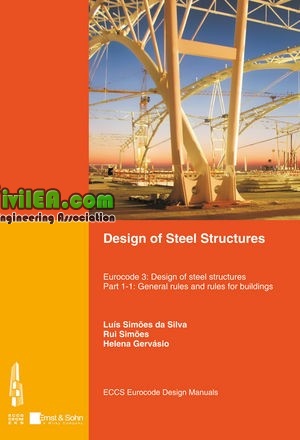
Design of Steel Structures: Eurocode 3: Design of steel structures, Part 1-1 - General rules and rules for buildings
Author: Luís Simões da Silva, Rui Simões, Helena Gervásio | Size: 3 MB | Format:PDF | Quality:Original preprint | Publisher: Ernst & Sohn, ECCS (European Convention for Constructional Steelwork) | Year: 2012 | Pages: 438 | ISBN: 9783433029732, 9783433601099
This book introduces the fundamental design concept of Eurocode 3 for current steel structures in building construction, and their practical application.
Following a discussion of the basis of design, including the principles of reliability management and the limit state approach, the material standards and their use are detailed. The fundamentals of structural analysis and modeling are presented, followed by the design criteria and approaches for various types of structural members. The theoretical basis and checking procedures are closely tied to the Eurocode requirements. The following chapters expand on the principles and applications of elastic and plastic design, each exemplified by the step-by-step design calculation of a braced steel-framed building and an industrial building, respectively.
Besides providing the necessary theoretical concepts for a good understanding, this manual intends to be a supporting tool for the use of practicing engineers. In order of this purpose, throughout the book, numerous worked examples are provided, concerning the analysis of steel structures and the design of elements under several types of actions. These examples will facilitate the acceptance of the code and provide for a smooth transition from earlier national codes to the Eurocode.
Code:
Content of this section is hidden, You must be registered and upgrade your account to see this content.
🔽🔽🔽🔽🔽🔽🔽🔽🔽
See this link to read how you can remove this limitation:
👉 CLICK HERE 👈
Code:
Content of this section is hidden, You must be registered and upgrade your account to see this content.
🔽🔽🔽🔽🔽🔽🔽🔽🔽
See this link to read how you can remove this limitation:
👉 CLICK HERE 👈
Code:
Content of this section is hidden, You must be registered and upgrade your account to see this content.
🔽🔽🔽🔽🔽🔽🔽🔽🔽
See this link to read how you can remove this limitation:
👉 CLICK HERE 👈
This book contains some new developments in the area of Structural Dynamics. In general it reflects the recent efforts of several Austrian research groups during the years 1985 - 1990. The contents of this book cover both theoretical developments as well as practical applications and hence can be utilized by researchers as well as the practicing engineers. Quite naturally, realistic modeling of a number of load types such as wind and earthquake loading, etc. , requires taking into account statistical uncertainties. Hence these loads have to be characterized by stochastic processes. As a consequence, stochastic aspects must play a major role in modem structural dynamics. Since an extended modeling of the load processes should not be counterbalanced by simplifying the structural models, considerable efforts have been put into the development of procedures which allow the utilization of e. g. FE models and codes which are utilized presently in context with simplified, i. e. "deterministic" load models. Thus the processing of the additional information on loads as well as including statistical properties of the material allows to provide additional answers, i. e. quantification of the risk of structural failure. This volume concentrates on four major areas, i. e. on load modeling, structural response analysis, computational reliability procedures, and finally on practical application. Quite naturally only special fields and particular, i. e. selected types of problems can be covered. Specific reference is made, however, to cases where generalizations are possible.
Code:
Content of this section is hidden, You must be registered and upgrade your account to see this content.
🔽🔽🔽🔽🔽🔽🔽🔽🔽
See this link to read how you can remove this limitation:
👉 CLICK HERE 👈
PDF file is OCR and searchable.
Code:
Content of this section is hidden, You must be registered and upgrade your account to see this content.
🔽🔽🔽🔽🔽🔽🔽🔽🔽
See this link to read how you can remove this limitation:
👉 CLICK HERE 👈
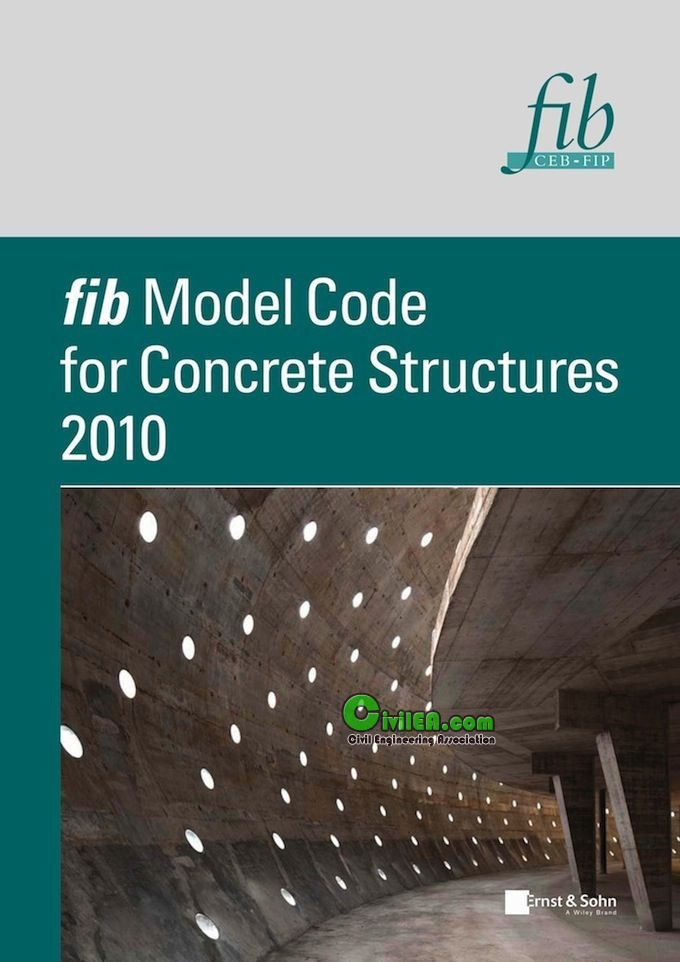
Author: fib - The International Federation for Structural Concrete (fédération internationale du béton) | Size: 14 MB | Format:PDF | Quality:Original preprint | Publisher: Ernst & Sohn | Year: 2013 | Pages: 402 | ISBN: 9783433030615, 9783433604083, 9783433604090, 9783433604212, 9783433604205
The International Federation for Structural Concrete (fib) is a pre-normative organization. 'Pre-normative' implies pioneering work in codification. This work has now been realized with the fib Model Code 2010. The objectives of the fib Model Code 2010 are to serve as a basis for future codes for concrete structures, and present new developments with regard to concrete structures, structural materials and new ideas in order to achieve optimum behaviour.
The fib Model Code 2010 is now the most comprehensive code on concrete structures, including their complete life cycle: conceptual design, dimensioning, construction, conservation and dismantlement. It is expected to become an important document for both national and international code committees, practitioners and researchers.
The fib Model Code 2010 was produced during the last ten years through an exceptional effort by Joost Walraven (Convener; Delft University of Technology, The Netherlands), Agnieszka Bigaj-van Vliet (Technical Secretary; TNO Built Environment and Geosciences, The Netherlands) as well as experts out of 44 countries from five continents.
Code:
Content of this section is hidden, You must be registered and upgrade your account to see this content.
🔽🔽🔽🔽🔽🔽🔽🔽🔽
See this link to read how you can remove this limitation:
👉 CLICK HERE 👈
EXE file is a self-extracting archive. There is no need for any program (WinRAR, 7Zip, ...) to extract the archive.
Code:
Content of this section is hidden, You must be registered and upgrade your account to see this content.
🔽🔽🔽🔽🔽🔽🔽🔽🔽
See this link to read how you can remove this limitation:
👉 CLICK HERE 👈