513 Seismic damage assessment for six RC bridges in the Veneto region (NE Italy)
Author: P. FRANCHETTI , M. GRENDENE , D. SLEJKO and C. MODENA | Size: 3 MB | Format:PDF | Quality:Unspecified | Publisher: Bollettino di Geofisica Teorica ed Applicata Vol. 49, n. 3-4, pp. 513-531; September-December 2008 | Year: 2008 | pages: 19
Seismic damage on six bridges in the Veneto region (NE Italy) is estimated by means of a probabilistic approach for seismic hazard assessment and by constructing the specific fragility curve for each bridge. Construction of fragility curves is based on
various approaches from literature. With the application of the best-performing approach on the six bridges a comparative preliminary evaluation of the expected damage on the bridges was done. However, as the methodology is general, it could easily be applied to bridges of an extensive number of road networks.
Code:
Content of this section is hidden, You must be registered and upgrade your account to see this content.
🔽🔽🔽🔽🔽🔽🔽🔽🔽
See this link to read how you can remove this limitation:
👉 CLICK HERE 👈
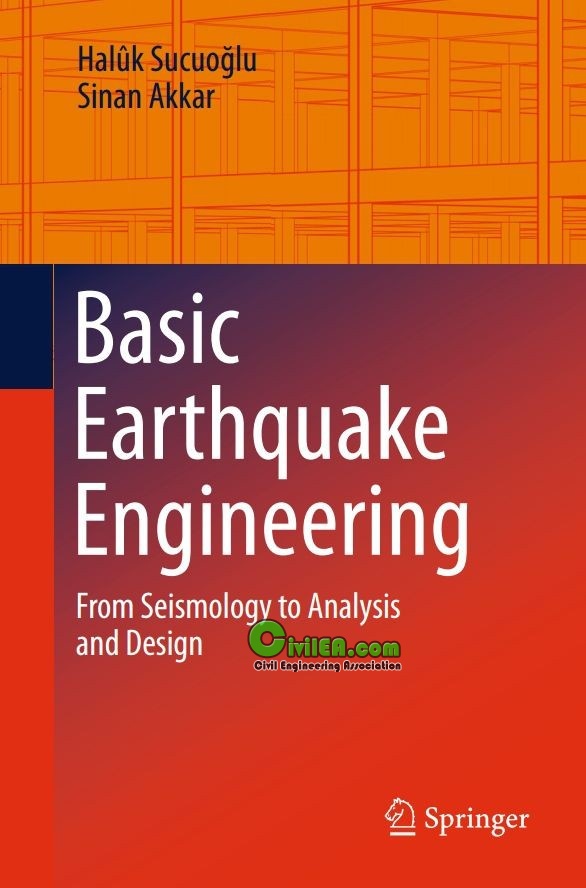
This book provides senior undergraduate students, master students and structural engineers who do not have a background in the field with core knowledge of structural earthquake engineering that will be invaluable in their professional lives. The basics of seismotectonics, including the causes, magnitude, and intensity of earthquakes, are first explained. Then the book introduces basic elements of seismic hazard analysis and presents the concept of a seismic hazard map for use in seismic design. Subsequent chapters cover key aspects of the response analysis of simple systems and building structures to earthquake ground motions, design spectrum, the adoption of seismic analysis procedures in seismic design codes, seismic design principles and seismic design of reinforced concrete structures. Helpful worked examples on seismic analysis of linear, nonlinear and base isolated buildings, earthquake-resistant design of frame and frame-shear wall systems are included, most of which can be solved using a hand calculator.
Features:
-Covers the seismic hazard, the basics of seismotectonics, and the fundamentals of earthquake engineering
-Meets the future professional needs of senior undergraduate students by explaining the principles of earthquake-resistant design
-Includes useful sample problems on earthquake-resistant design of frame and frame-shear wall systems
Code:
Content of this section is hidden, You must be registered and upgrade your account to see this content.
🔽🔽🔽🔽🔽🔽🔽🔽🔽
See this link to read how you can remove this limitation:
👉 CLICK HERE 👈
Code:
Content of this section is hidden, You must be registered and upgrade your account to see this content.
🔽🔽🔽🔽🔽🔽🔽🔽🔽
See this link to read how you can remove this limitation:
👉 CLICK HERE 👈
Code:
Content of this section is hidden, You must be registered and upgrade your account to see this content.
🔽🔽🔽🔽🔽🔽🔽🔽🔽
See this link to read how you can remove this limitation:
👉 CLICK HERE 👈
Author: Nasr Younis Abboushi | Size: I "19", II "29" MB | Format:PDF | Quality:Original preprint | Publisher: Palestine Polytechnic University | Year: 2013-2014 | pages: I "188", II "282"
ACI 318M-08 Reinforced Concrete I & II
by Nasr Younis Abboushi
ACI 318M-08 Reinforced Concrete I
CHAPTER 1 REINFORCED CONCRETE STRUCTURES
CHAPTER 2 MATERIALS AND PROPERTIES
CHAPTER 3 DESIGN METHODS AND REQUIREMENTS
CHAPTER 4 FLEXURE IN BEAMS
CHAPTER 5 SHEAR IN BEAMS
CHAPTER 6 COLUMNS: COMBINED AXIAL LOAD AND BENDING
CHAPTER 7 SLENDER COLUMNS
ACI 318M-08 Reinforced Concrete II
CHAPTER 8 ONE-WAY SLABS
CHAPTER 9 TWO-WAY SLABS
CHAPTER 10 STAIRS
CHAPTER 11 FOOTINGS AND FOUNDATIONS
CHAPTER 12 DEVELOPMENT, ANCHORAGE, AND SPLICING OF REINFORCEMENT
Code:
Content of this section is hidden, You must be registered and upgrade your account to see this content.
🔽🔽🔽🔽🔽🔽🔽🔽🔽
See this link to read how you can remove this limitation:
👉 CLICK HERE 👈
SHEAR STREN GTH OF CIRCULAR REINFORCED CONCRETE COLUMNS
Author: Lisa Y. Choe | Size: 29 MB | Format:PDF | Quality:Unspecified | Publisher: The Ohio State University | Year: 2006 | pages: 77
In this research, the influence of parameters on the shear strength of circular reinforced concrete columns is investigated based on the evaluation of experimental data from numerous column tests. Key parameters investigated in shear strength model are the column aspect ratio, axial load, amount of transverse reinforcement, and deformation ductility demand. An examination of existing design equations reveals wide difference in predicted response. Also, the shear strength model for rectangular reinforced concrete columns proposed by Sezen et al. (2004) is used for evaluating whether it is applicable to predict the shear strength of circular columns. The proposed shear strength equation by
Sezen et al. (2004) is composed of additive contributions from concrete and transverse reinforcement, and is a function of displacement ductility. The model proposed by Sezen et al. (2004) is compared with contemporary code provisions and previously proposed models using the available column test data and is shown to result in improved accuracy.
Code:
Content of this section is hidden, You must be registered and upgrade your account to see this content.
🔽🔽🔽🔽🔽🔽🔽🔽🔽
See this link to read how you can remove this limitation:
👉 CLICK HERE 👈
A NEW MODEL FOR JOINT SHEAR FAILURE OF REINFORCED CONCRETE INTERIOR BEAM-TO-COLUMN JOINT
Author: Hitoshi SHIOHARA | Size: 725 KB | Format:PDF | Quality:Unspecified | Publisher: Journal of the School of Engineering, The University of Tokyo, Vol. XLV (1998) | Year: 1998 | pages: 30
The primary objective of this study is to point out an irrationality in the joint shear failure model, which is adopted in the most current design codes of reinforced concrete beam-to-column joint. To examine this issue, tests of twenty reinforced concrete interior beam-to-columnjoint failed in joint shear are reexamined. The data indicated that joint shear stress had increased in the most specimens, even after apparent joint shear failure starts, while beam moment decreases due to decrease of flexural resistance which is caused by reduction of distance between stress resultants in beam at column face. The cause of the deterioration of story shear is identified to be a degrading of moment resistance of joint, originated from a finite upper limit of anchorage capacity of beam reinforcements through the joint core. So a new mathematical model for joint shear failure is introduced to reflect this fact. The behavior of the
model is investigated and a new approach for the design of beam-to-column joint in seismic zone is proposed based on the prediction of the model.
Code:
Content of this section is hidden, You must be registered and upgrade your account to see this content.
🔽🔽🔽🔽🔽🔽🔽🔽🔽
See this link to read how you can remove this limitation:
👉 CLICK HERE 👈