This is a paper about the determination of design moments in bridges
constructed by balanced cantilever method.
This paper introduces an equation to calculate the design moments in reinforced concrete (RC) bridges constructed by the balanced cantilever method. Through time-dependent analyses of RC bridges, considering the construction sequence and creep deformation
of concrete, structural responses related to the member forces are reviewed. On the basis of the compatibility condition at every construction stage, a basic equation which can describe the moment variation with time in the balanced cantilever construction is derived.
Code:
Content of this section is hidden, You must be registered and upgrade your account to see this content.
🔽🔽🔽🔽🔽🔽🔽🔽🔽
See this link to read how you can remove this limitation:
👉 CLICK HERE 👈
Dear Friends,
Any body can help to find the book of Schlaich, J (1982), “Detailing of Concrete Structures - First Draft of a Design Manual (in German)"
Out of print: available only as scanned copy (PDF file on CD).
(1982)
Comité Euro-International du Béton, Paris, March 1982, 163 pp
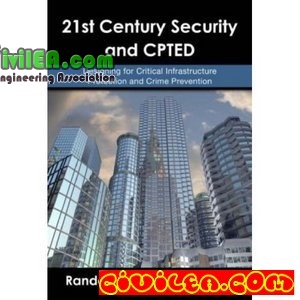
21st Century Security and CPTED: Designing for Critical Infrastructure Protection and Crime Prevention
21st Century Security and CPTED: Designing for Critical Infrastructure Protection and Crime Prevention
By Randall I. Atlas
Publisher: Auerbach Publications
Number Of Pages: 560
Publication Date: 2008-05-28
ISBN-10 / ASIN: 1420068075
ISBN-13 / EAN: 9781420068078
Binding: Hardcover
Product Description:
Offering one important answer to current concerns with violence and terrorism, this is the only book to examine current trends in the developing field of Crime Prevention through Environmental Design (CPTED). It includes contributions from the world's top CPTED practitioners. Highly relevant to critical infrastructure protection, the book addresses application of CPTED to high-security environments, as well as public and private sector buildings. Facilitating understanding across fields, it explains the architecture process to security directors, while explaining the security design process to architects. It serves as a practical guide for architects, security directors, law enforcement, Homeland Security professionals, building and property managers, as well as criminal justice, architecture, and security students.
Code:
Content of this section is hidden, You must be registered and upgrade your account to see this content.
🔽🔽🔽🔽🔽🔽🔽🔽🔽
See this link to read how you can remove this limitation:
👉 CLICK HERE 👈
Code:
Content of this section is hidden, You must be registered and upgrade your account to see this content.
🔽🔽🔽🔽🔽🔽🔽🔽🔽
See this link to read how you can remove this limitation:
👉 CLICK HERE 👈
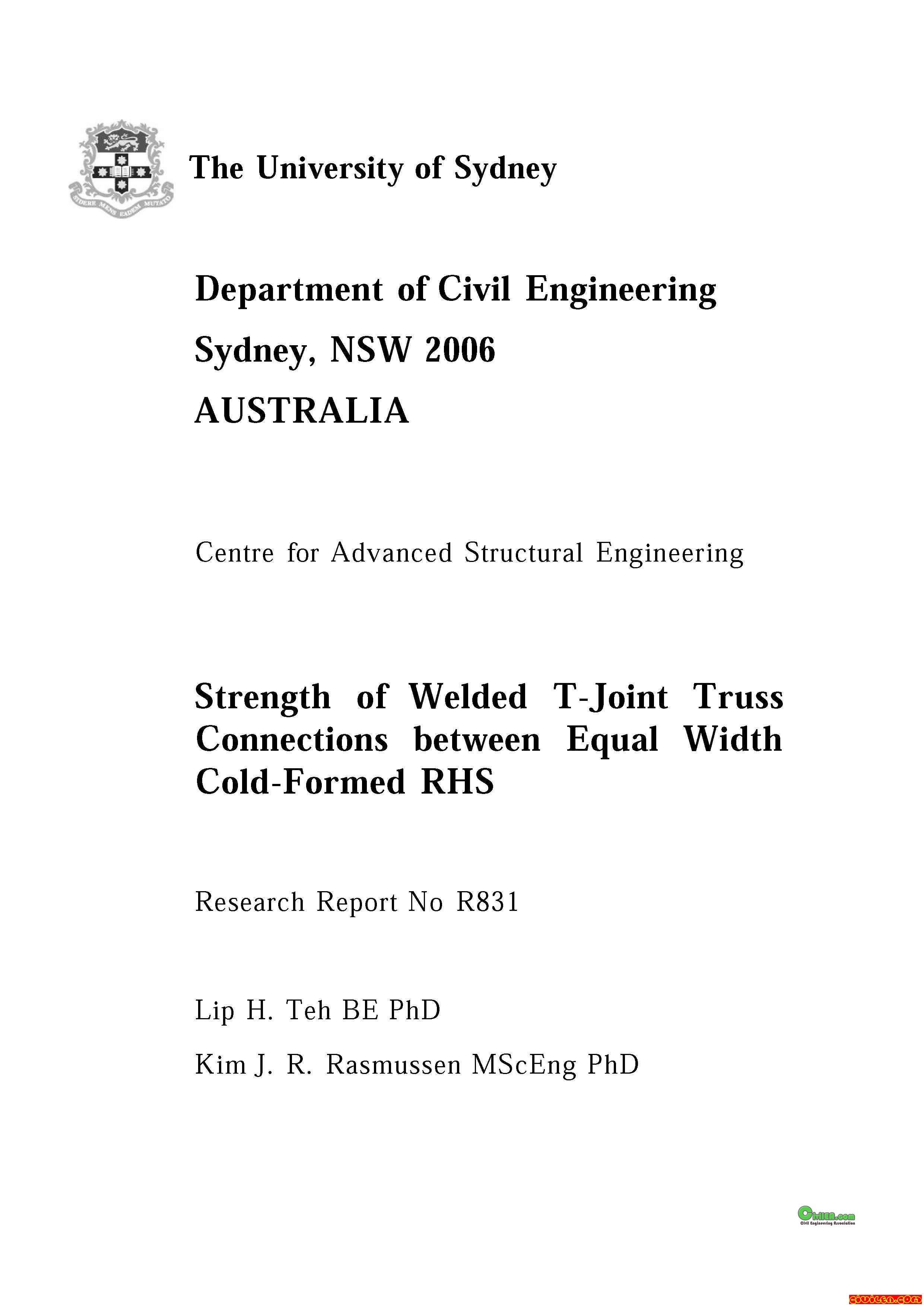
The report describes laboratory tests of arc welded T-joints between equal width rectangular
hollow sections. The brace and chord members were cold formed with a nominal yield stress
of 350 MPa. The welds were laid using MMAW and GMAW processes without profiling the
brace ends. The brace of each specimen was loaded in tension to failure with the chord
supported continuously so as not to induce significant bending effects.
The test results showed that the joint strength can be improved by using backing strips for the
butt welds, while backing rods (or filler rods) should not be used as they led to larger
variation in joint strengths, and often, inferior strengths. The test strengths are compared with
the design strengths obtained using the IIW Recommendations and Eurocode3, Part 1.8. It is
shown that for cold-formed tubes with a nominal yield stress of 350 MPa (or above), a design
check on the strength of the butt (or groove) weld is required in addition to the checks on the
strengths of the chord and brace members specified in the current design guidelines. An
equation is proposed for calculating the strength of the weld.
Keywords: butt weld, brace-to-chord connection, cold-formed steel, metal arc welding,
rectangular hollow section, T-joint design
28 pages
Code:
Content of this section is hidden, You must be registered and upgrade your account to see this content.
🔽🔽🔽🔽🔽🔽🔽🔽🔽
See this link to read how you can remove this limitation:
👉 CLICK HERE 👈
Code:
Content of this section is hidden, You must be registered and upgrade your account to see this content.
🔽🔽🔽🔽🔽🔽🔽🔽🔽
See this link to read how you can remove this limitation:
👉 CLICK HERE 👈