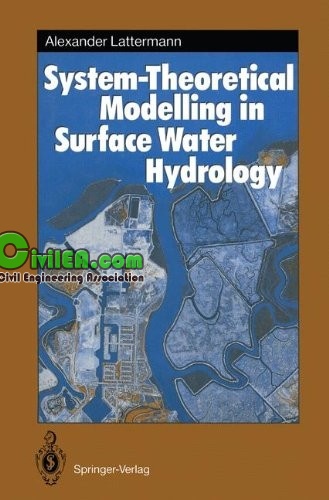
Modelling of hydrological rainfall-runoff processes is facilitated by the application of the systemtheoretical approach to linear, nonlinear and stochastic models. To this purpose, the variables involved in methods for determinating areal precipitation and baseflow separation are discussed. The convolution theorem in the theory of linear systems and the mathematical transform technique (Laplace-, Z-transformation) are used to identify characteristics of the watershed, and simulate hydrological processes. To support the calculation of model output functions, computer programs are included in the text. This volume is suitable as a text for hydrology courses at universities or engineering academies.
Code:
Content of this section is hidden, You must be registered and upgrade your account to see this content.
🔽🔽🔽🔽🔽🔽🔽🔽🔽
See this link to read how you can remove this limitation:
👉 CLICK HERE 👈
I'm looking for the following document ACI 440.2R-17: Guide for the Design and Construction of Externally Bonded FRP Systems for Strengthening Concrete Structures. Thanks and Regards
Code:
Content of this section is hidden, You must be registered and upgrade your account to see this content.
🔽🔽🔽🔽🔽🔽🔽🔽🔽
See this link to read how you can remove this limitation:
👉 CLICK HERE 👈
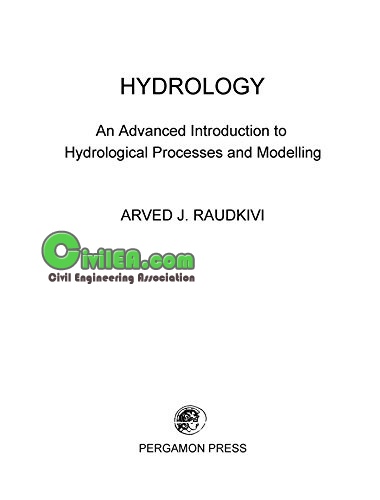
Hydrology: An Advanced Introduction to Hydrological Processes and Modelling introduces the reader to hydrological processes and methods of estimation of the various quantities involved. Topics covered range from elements of meteorology to precipitation, evaporation and transpiration, interception, and flood routing. Extreme events, design flood, and small catchment runoff are also discussed.
This book is comprised of 12 chapters and begins with an overview of hydrology and the hydrologic cycle, along with the world's water resources and their utilization and management. Subsequent chapters deal with atmospheric thermodynamics and atmospheric circulation; analysis and measurement of precipitation, evaporation, transpiration, and interception; infiltration of groundwater; and reservoir and stream routing. Storage for flood control and regulation for abatement of water shortage are also considered, along with stratification and siltation of reservoirs, catchment yield, and sediment yield and transport. The final chapter highlights the importance of information analysis and decision making in hydrological work.
This monograph is written for senior and postgraduate students and should also be of value to practitioners of physics, mathematics, and civil engineering.
Code:
Content of this section is hidden, You must be registered and upgrade your account to see this content.
🔽🔽🔽🔽🔽🔽🔽🔽🔽
See this link to read how you can remove this limitation:
👉 CLICK HERE 👈
BS EN 673, Glass in building — Determination of thermal transmittance (U value) — Calculation method
BS EN 674, Glass in building — Determination of thermal transmittance (U value) — Guarded hot plate method
BS EN 675, Glass in building — Determination of thermal transmittance (U value) — Heat flow meter method
Code:
Content of this section is hidden, You must be registered and upgrade your account to see this content.
🔽🔽🔽🔽🔽🔽🔽🔽🔽
See this link to read how you can remove this limitation:
👉 CLICK HERE 👈
Code:
Content of this section is hidden, You must be registered and upgrade your account to see this content.
🔽🔽🔽🔽🔽🔽🔽🔽🔽
See this link to read how you can remove this limitation:
👉 CLICK HERE 👈