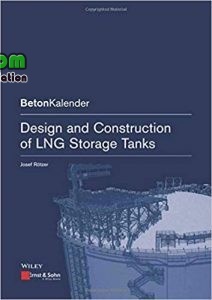
Worldwide, the use of natural gas as a primary energy source will remain vital for decades to come. This applies to industrialized, emerging countries and developing countries. Owing to the low level of impurities, natural gas is considered to be a climate-friendly fossil fuel because of the low CO2 emissions, but is at the same time an affordable source of energy.
In order to enable transport over long distances and oceans (and hence create an economic and political alternative to pipelines), the gas is liquefied, which is accompanied by a considerable reduction in volume, and then transported by ship. Thus, at international ports, many LNG tanks are required for temporary storage and further use. The trend towards smaller liquefaction and regasification plants with associated storage tanks for marine fuel applications has attracted new players in this market who often do not yet have the necessary experience and technical expertise. It is not sufficient to refer to all existing technical standards when defining consistent state-of-the-art specifications and requirements.
The switch to European standardisation has made it necessary to revise and adapt existing national codes to match European standards. Technical committees at national and international level have begun their work of updating and completing the EN 14620 series.
In the USA, too, the corresponding regulations are also being updated. The revision of American Concrete Institute standard ACI 376 Requirements for Design and Construction of Concrete Structures for the Containment of Refrigerated Liquefied Gases, first published in 2011, will be completed in the spring of 2019, and the final version, published in autumn 2019.
This book provides an overview of the state of the art in the design and construction of liquefied natural gas (LNG) tanks. Since the topic is very extensive and complex, an introduction to all aspects is provided, e.g. requirements and design for operating conditions, thermal design, hydrostatic and pneumatic tests, soil surveys and permissible settlement, modelling of and calculations for the concrete structure, and the actions due to fire, explosion and impact. Dynamic analysis and the theory of sloshing liquid are also presented.
Code:
Content of this section is hidden, You must be registered and upgrade your account to see this content.
🔽🔽🔽🔽🔽🔽🔽🔽🔽
See this link to read how you can remove this limitation:
👉 CLICK HERE 👈
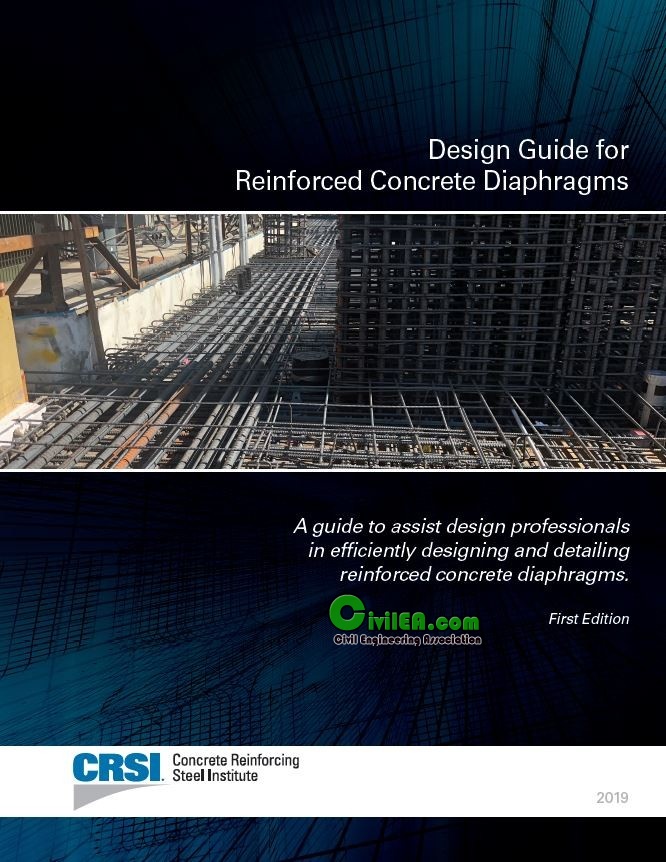
Design Guide for Reinforced Concrete Diaphragms A guide to assist design professionals in efficiently designing and detailing reinforced concrete diaphragms
with the 2014 edition of Building Code Requirements for Structural Concrete (ACI 318-14) and Commentary (ACI 318R-14) [Reference 1].
One of the main goals is to provide step-by-step design procedures and design aids that make designing and detailing reinforced
concrete diaphragms simpler and faster. The procedures and design aids contained in this publication can be used in the design
and detailing of reinforced concrete diaphragms in buildings of any size that are assigned to Seismic Design Categories A through F.
The 2018 edition of the International Building Code (IBC) [Reference 2] references ACI 318-14, and Section 1901.2 of the IBC requires
that structural concrete be designed and constructed in accordance with the provisions of Chapter 19 of the IBC and the
2014 edition of ACI 318 as amended in IBC Section 1905. Thus, ACI 318 is part of the IBC and its applicable provisions must be
satisfied when the IBC is adopted in a jurisdiction.
It is important to note that ACI 318 provides minimum requirements for the materials, design, construction, and strength evaluation
of structural concrete members and systems in any structure designed and constructed under the requirements of the
general building code, such as the IBC. The purpose and applicability of the requirements in ACI 318-14 can be found in Sections
1.3 and 1.4 of that document, respectively.
The requirements of the 2016 edition of ASCE/SEI 7 Minimum Design Loads and Associated Criteria for Buildings and Other Structures
(Reference 3) are also used throughout this publication, including several important provisions pertaining to diaphragm loading
and Seismic Design Category (SDC).
Code:
Content of this section is hidden, You must be registered and upgrade your account to see this content.
🔽🔽🔽🔽🔽🔽🔽🔽🔽
See this link to read how you can remove this limitation:
👉 CLICK HERE 👈
This book is about geoplasticity, solid mechanics of rock, jointed rock and soil beyond the domain of a purely elastic deformation. Plastic deformation is irreversible and begins at the limit to elasticity with any attempt at further loading. Stress at the limit to elasticity is "strength" which is described by a functional relationship amongst stresses, that is, by a yield function or failure criterion. Mohr-Coulomb, Drucker-Prager and Hoek-Brown criteria are well-known examples in geomechanics
Code:
Content of this section is hidden, You must be registered and upgrade your account to see this content.
🔽🔽🔽🔽🔽🔽🔽🔽🔽
See this link to read how you can remove this limitation:
👉 CLICK HERE 👈
Kojan, E., and Hutchinson, J.N (1978) Mayunmarca Rockslide and debris flow, peru, pp. 315-361 in rockslides and avalanches, vol. 1, natural phenomena, Voight, B., ed., Elsevier, Amsterdam
Gregersen, O. (2005). ‘‘Program for okt sikkerhet mot leirskred. Risiko for kvikkleireskred Bragernes, Drammen’’. Report 2004 1343-1. Norwegain Geotechncial institute, 26 January 2005.